


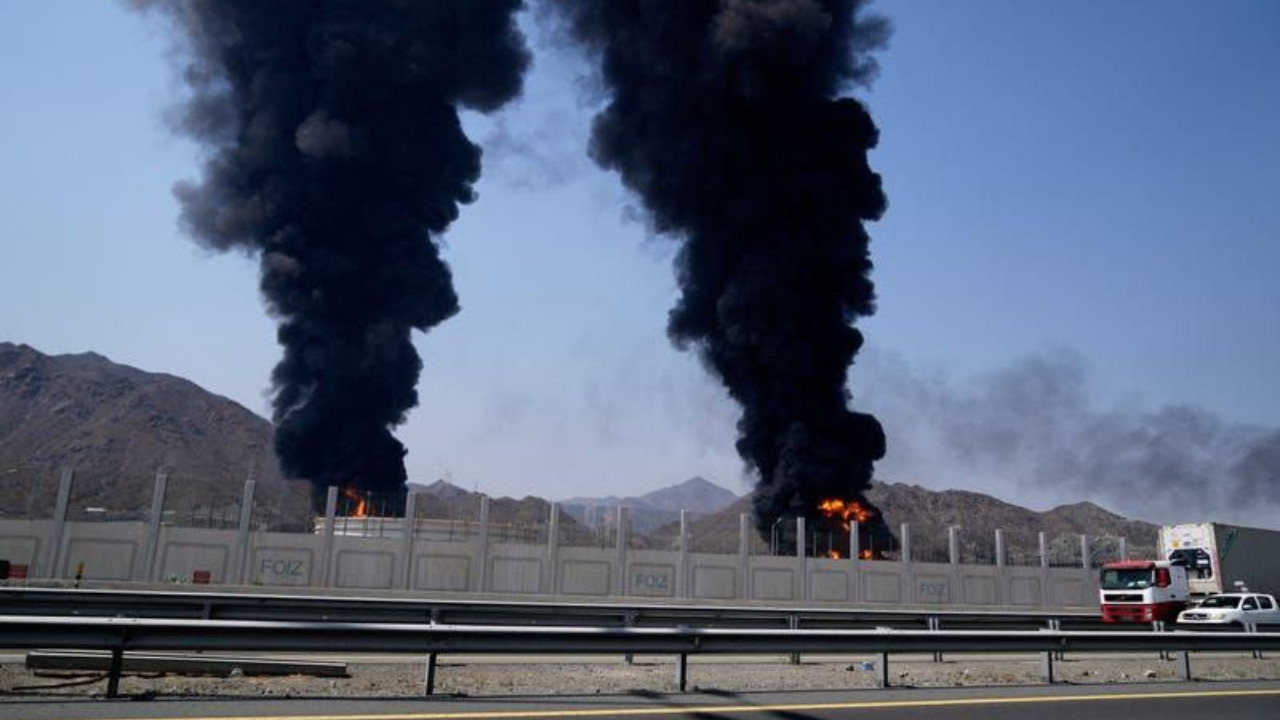
Following the killing of senior Iranian official Ali Larijani, Israel has made it clear that it will continue its military operations and that, for the time being, there is no possibility of any de-escalation. (Image X @MEC_Tracker)
New Delhi: Following the killing of senior Iranian official Ali Larijani, Israel has made it clear that it will continue its military operations and that, for the time being, there is no possibility of any de-escalation. Israel's Ambassador to India, Reuven Azar, has stated that the conflict will persist until there is a change in Iran's policies or its leadership.
Talking to the media, Israeli Ambassador to India Reuven Azar remarked that the strikes—in which senior commander Gholamreza Soleimani is reported to have been killed—are part of a sustained campaign aimed at degrading Iran's military capabilities. Furthermore, he asserted that these attacks have inflicted significant damage upon Iran's power, reducing its overall capabilities by approximately 80 percent.
Israeli Prime Minister Benjamin Netanyahu has also confirmed that Larijani was eliminated. He stated that this action was undertaken to undermine Iran's security infrastructure. According to him, this step was essential for mitigating the threat emanating from the region.
Additionally, Ambassador Reuven Azar noted that Israel's military reach now extends deeper than ever before. He explained that Israel is consistently penetrating deep into Iranian territory to target key strategic sites. The objective of this campaign is to completely dismantle Iran's military structure.
He also made it clear that, for the moment, there is no prospect of peace or de-escalation. In his words, Israel will not back down until a major shift occurs within Iran. He pointed out that, despite decades of diplomatic engagement, Iran has shown no willingness to alter its nuclear program, ballistic missile development, or regional activities.
Israel has also articulated its objectives regarding this conflict. According to Reuven Azar, Israel is determined to prevent Iran from acquiring nuclear weapons. Furthermore, he seeks to curtail Iran's ballistic missile program and dismantle its network of regional proxy groups.
Reuven Azar also asserted that, according to intelligence reports, Iran is moving critical components of its nuclear and missile programs deep underground. This could make it difficult to strike these facilities in the future. He stated that this is precisely why military action has become necessary at this juncture.
Although Israel has not explicitly called for regime change, Azar noted that this conflict could conclude in various ways. These possibilities include a weakening of Iran's current regime, a shift in its policies, or even a change in governance. He further emphasized that any political transformation within Iran is ultimately a matter for the Iranian people themselves to decide.
The Israeli Ambassador also claimed that internal pressure is mounting within Iran and that certain vulnerabilities are becoming apparent within its security apparatus. However, these claims have not been independently verified. Addressing the role of the United States, Azar described the ongoing campaign as a joint effort. He noted that both the U.S. and Israel share aligned strategic interests and are working in tandem. He also clarified that neither nation acts at the behest of the other; rather, each makes decisions based on its own national interests.
Responding to questions regarding civilian casualties, Azar stated that Israel's objective is strictly to target military installations. He acknowledged that tragic incidents may occur during the course of a conflict, but emphasized that targeting civilians is not—and never has been—Israel's policy. He further asserted that Israel views the targeting of Iran's top leadership as a legitimate course of action, given that, in its view, Iran has long orchestrated attacks against Israel through various proxy groups.
Commenting on the regional landscape, Azar observed that while many Arab nations may not publicly express support for Israel, they remain deeply concerned about Iran's activities. He indicated that, in private, a number of these nations are sympathetic to and understand the rationale behind Israel's actions. Regarding India's stance, he stated that India makes decisions based on its national interests, and Israel respects this independent policy. He also clarified that there were no plans to attack Iran during Prime Minister Narendra Modi's recent visit, and that this action was decided upon at a later stage.
In conclusion, Azar remarked that the duration of this conflict would depend on the unfolding circumstances. He stated that while Israel is prepared for a prolonged conflict, its objective is not perpetual war. He made it clear that Israel would continue its operations until its primary objectives are achieved.





Copyright © 2026 Top Indian News


