


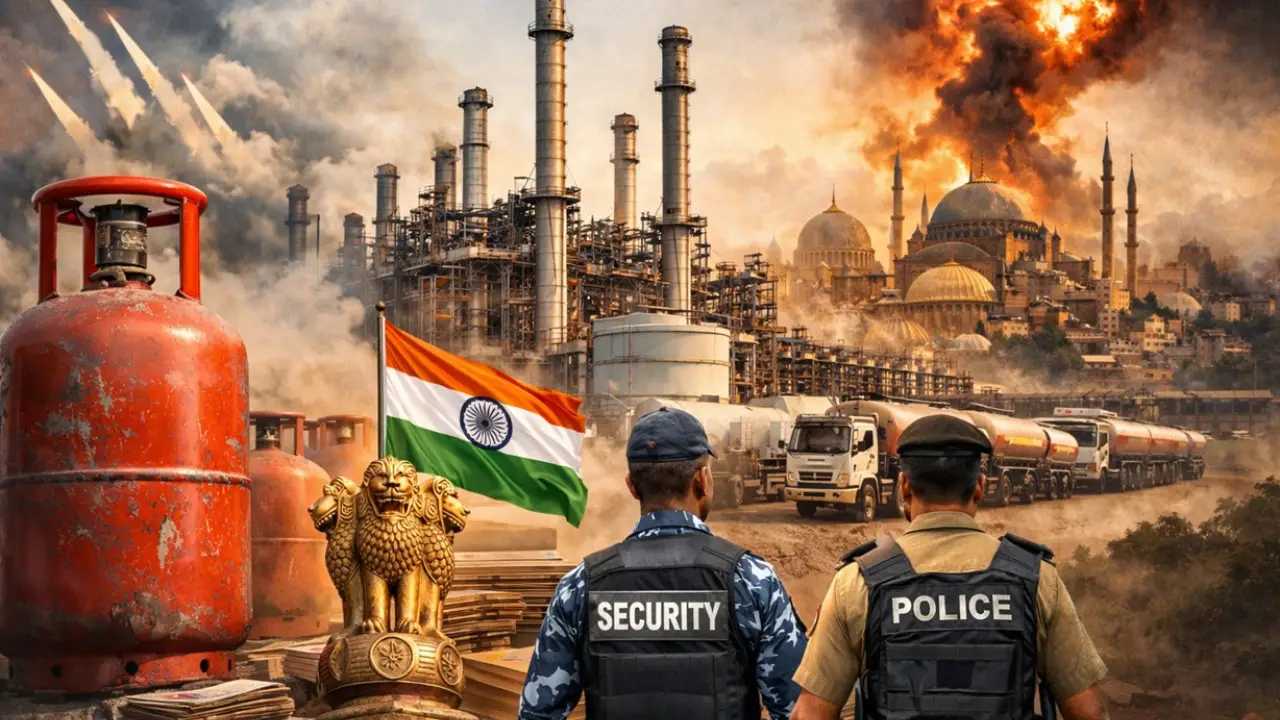
Central Government Invokes ESMA Nationwide as West Asia Crisis Raises Supply Concerns (OpenAi)
New Delhi: Amidst the increasing tension in the Middle East and uncertainty in the global energy market, the central government has taken a major step to maintain uninterrupted supply of domestic gas in the country. The government has implemented ESMA (Essential Services Maintenance Act) across the country. Under this, instructions have been given to the refinery and petrochemical units to maximize LPG production and to send major hydrocarbon sources to the LPG pool so that the domestic gas supply is not affected.
ESMA i.e. Essential Services Maintenance Act is a law passed by the Indian Parliament in 1968. Its objective is to ensure the supply of such services whose disruption may affect the daily life of the general public. Under this Act, employees engaged in essential services cannot strike or stop work. It is commonly used to prevent disruption to health, transportation, electricity and other essential services. This law can be implemented for a maximum of six months.
Under this Act, public safety, sanitation, water supply, hospital services and services related to national defense are considered essential. Apart from this, establishments related to production and distribution of petroleum, coal, electricity, steel and fertilizer are also included in it. Government initiatives related to banking services, communications, transportation and procurement and distribution of food grains may also fall within the scope of ESMA.
The government has not taken this step suddenly. Recently there has been increased volatility in the global energy market due to increasing military tensions between Iran, US and Israel. Due to this, fluctuations are being seen in the prices of LPG and natural gas. There is a fear that if the supply is disrupted, the availability of domestic gas may be affected. To deal with this situation, the center first increased the LPG cylinder booking period from 21 days to 25 days and has now implemented ESMA so that hoarding and panic buying can be stopped.
According to officials, people had started booking more cylinders due to the fear of supply disruption due to the war in the Middle East. Due to this, demand increased by about 15 to 20 percent. Typically a family uses around 7 to 8 cylinders of 14.2 kg each in a year and they do not need to refill the cylinder earlier than six weeks.
Government officials have clarified that despite the price of crude oil reaching above $100 per barrel in the international market, there will be no increase in the prices of petrol and diesel at present. Oil marketing companies like Indian Oil, Bharat Petroleum and Hindustan Petroleum will bear the cost pressure themselves for now.
The government told Parliament that India currently has a total of 74 days of strategic reserves of crude oil and petroleum products. This storage capacity will help the country maintain energy supplies in case of any geopolitical crisis or supply disruption.
The government says that at present there is adequate availability of LPG in the country and the situation is being constantly monitored so that the common people do not face any kind of problem.


Copyright © 2026 Top Indian News


