


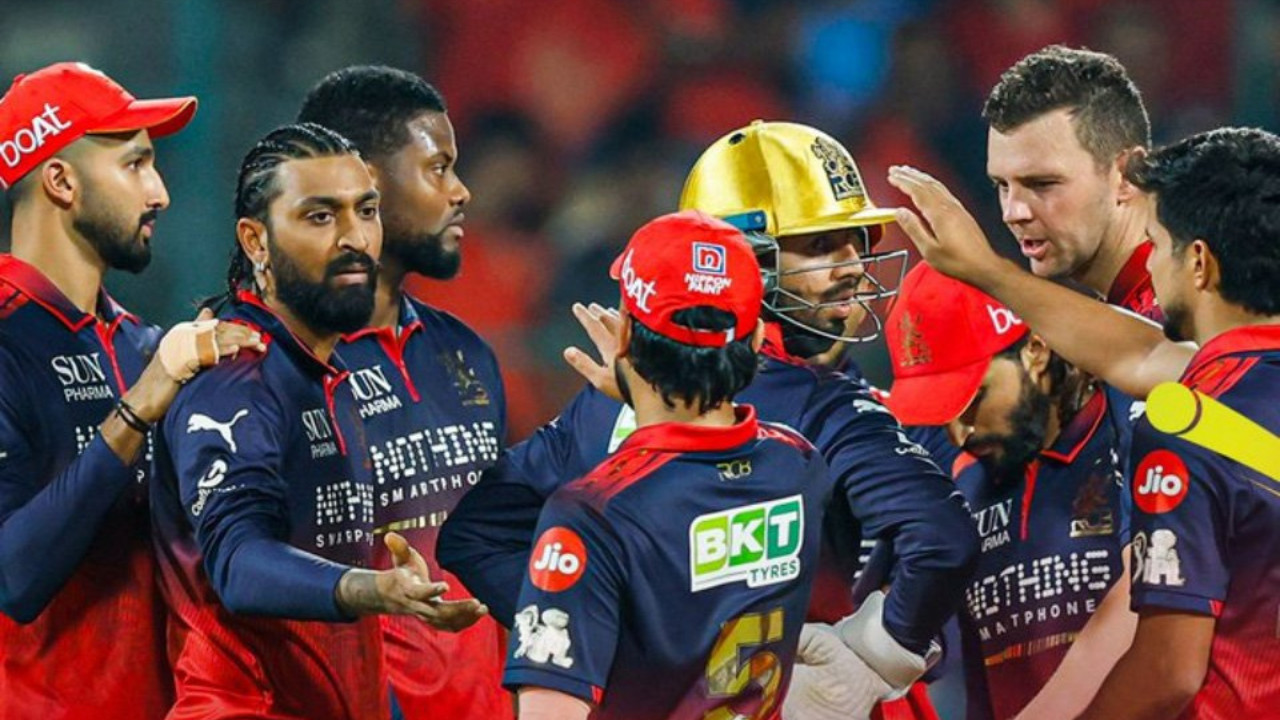
The record for the lowest score in the history of the IPL is held by Royal Challengers Bangalore. (Image X @Akshatgoel1408)
New Delhi: The record for the lowest score in the history of the IPL is held by Royal Challengers Bangalore. Kolkata Knight Riders bowled out RCB for a mere 49 runs during the 2017 season. RCB had an opportunity to offload this ignominious record onto Delhi Capitals, but they missed the chance. The Delhi Capitals team surpassed the 49-run mark.
With this victory, RCB's position in the points table has been further strengthened. RCB has now climbed to the second spot with 12 points from 8 matches. Meanwhile, following this defeat, Delhi sits at the 7th position, having secured only 3 wins in 8 matches.
Delhi Capitals scored 75 runs in 16.3 overs. This marks Delhi's third-lowest total in the IPL. Josh Hazlewood claimed four wickets, while Bhuvneshwar Kumar took three. Having won the toss, the opposing captain invited DC to bat first. Batting after losing the toss, Delhi got off to a poor start. DC lost six wickets while adding a mere 9 runs to the scoreboard. RCB's score at the end of the Powerplay stood at 13/6. This represents the lowest Powerplay score in the history of the IPL. Sahil Parekh returned to the pavilion in the very first over; he was bowled by Bhuvneshwar Kumar. KL Rahul, who had played an unbeaten innings of 152 runs in the previous match, also failed to make an impact with the bat; he scored just one run off three deliveries. In the second over, on the very first ball, Josh Hazlewood dismissed Rahul—who was caught by wicketkeeper Jitesh Sharma. On the second ball of the same over, Sameer Rizvi (0) also handed a catch to Jitesh.
Batting first after losing the toss, Delhi Capitals got off to a disastrous start. The team lost six of its wickets for a mere 8 runs. Within just three overs, the duo of Bhuvneshwar Kumar and Josh Hazlewood completely dismantled the Delhi batting lineup. Sahil Parekh, Sameer Rizvi, and Axar Patel failed to even open their accounts. KL Rahul and Nitish Rana scored one run each, while Tristan Stubbs contributed 5 runs. By the end of the Powerplay, Delhi Capitals' score stood at just 13 runs. This also marks the lowest Powerplay score in the history of the IPL.
The Impact Player rule did not exist back when the RCB team was bowled out for just 49 runs. In this match, however, it was the Impact Player who came to Delhi Capitals' rescue. Delhi brought in left-handed batsman Abhishek Porel as their Impact Player. He played the highest-scoring innings for the team, facing 33 balls. He eventually fell victim to Josh Hazlewood as the final batsman to be dismissed.
KL Rahul and debutant Sahil Parakh opened the innings for Delhi. However, Bhuvneshwar clean bowled Sahil on just the second delivery. In the very next over, Hazlewood dismissed both KL Rahul and Sameer Rizvi, and in the following over, Bhuvi struck again to claim the wickets of Stubbs and Axar. In other words, within just 2.4 overs, Delhi had lost 5 wickets for a mere 7 runs. Yet, Delhi's troubles were far from over; in the fourth over, Hazlewood dismissed Nitish Rana as well. Delhi had lost 6 wickets with the score standing at 8. However, David Miller and Porel subsequently stepped up to stabilize the innings.
But in the 9th over, Rasikh claimed the wicket of David Miller. Miller was dismissed after scoring 16 runs. Following this, Delhi's innings failed to recover and eventually folded in the 17th over for a total score of just 75 runs. For RCB, Bhuvi took 3 wickets for 5 runs in 3 overs, while Josh Hazlewood claimed 4 wickets for 12 runs in 3.3 overs.
Chasing a target of 76 runs, RCB's innings was opened by Virat Kohli and Jacob Bethell. Bethell scored 20 runs off 11 balls before losing his wicket in the third over. However, following this, Kohli and Devdutt Padikkal batted magnificently. The duo successfully chased down the entire target of 76 runs within just the 7th over. Kohli sealed the victory for RCB by smashing two consecutive sixes. Kohli remained unbeaten on 23 runs off 15 balls, while Devdutt powered his way to an unbeaten 34 runs off 13 balls.


Copyright © 2026 Top Indian News


