


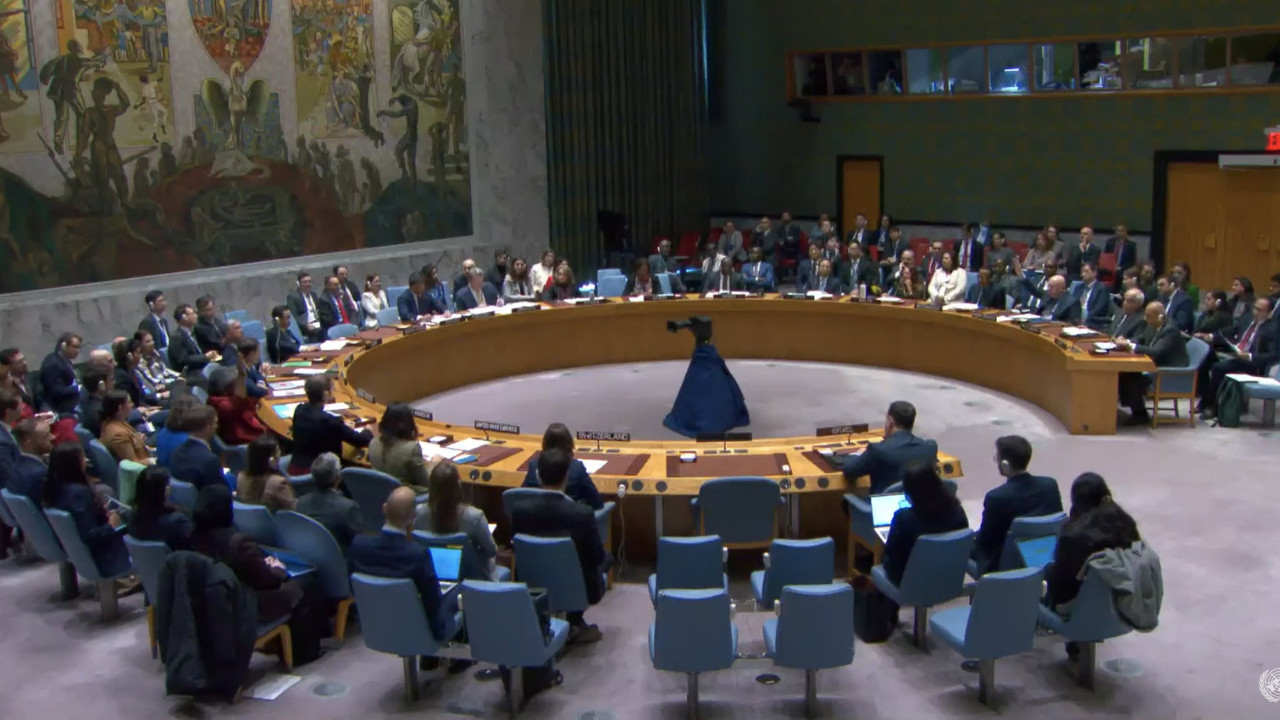
India issued a warning along with the G4 countries regarding the demand for reforms in the United Nations Security Council. (Image X @UN_News_Centre)
New York: India has strongly criticized the United Nations. India's Permanent Representative to the UN, Parvathaneni Harish, issued a warning along with the G4 countries regarding the demand for reforms in the United Nations Security Council (UNSC). The demand for reforms in the UNSC has been ongoing for a long time. However, these reforms have been stalled for years due to the intransigence of the permanent members of the UNSC.
India is also a member of the G4, which has long advocated for reforms in the United Nations Security Council. The G4 includes India, Brazil, Germany, and Japan, who also support each other's bids for permanent seats in the UNSC. Currently, Pakistan is also a non-permanent member of the UNSC from the Asia-Pacific region. Its membership will end in December 2026.
The G4 countries stated that delays in Security Council reforms would lead to more suffering and hardship for humanity. The G4 also presented a model for swift action to restructure the UN's highest decision-making body. India's bid for permanent membership in the UN has been supported by several countries. Speaking on behalf of the G4 at the Intergovernmental Negotiations (IGN) on Security Council reform on Wednesday, India's Permanent Representative to the UN, Parvathaneni Harish, said, "Countless innocent lives are being lost every day in ongoing conflicts, so we must make every moment count."
The Indian representative said, "The world is going through unprecedented times. The credibility and effectiveness of the UN are being questioned because it is failing to address the escalating conflicts. For decades, those who want to maintain the status quo have been creating obstacles and hindering progress. By doing so, they are contributing to the Security Council's failures."
According to the reform process, the IGN is facing obstacles from a small group of countries. These countries call themselves the Uniting for Consensus (UFC) group and employ procedural tactics to prevent the adoption of a text to move forward in the negotiations. Italy's Deputy Permanent Representative, Gianluca Greco, insisted that there must be a consensus on all issues before a text outlining the reforms can be introduced. He also reiterated the purpose of the UFC, which is to prevent the expansion of permanent membership in the UN.
P. Harish stated that the G4 is clear that text-based negotiations, with clearly defined milestones and timelines, are central to the IGN process. He said the G4 is committed to working towards a consolidated model as a starting point for text-based negotiations. The consolidated model would bring together the suggestions of all UN members and present them in a way that facilitates negotiations. India's Permanent Representative outlined the G4's concrete model for reforms, covering all categories and regions.
He said the size of the Council should be increased from the current 15 to 25 or 26, with six new permanent seats. A fundamental principle behind the G4 model is to reflect today's geopolitical realities. To this end, two of the six new permanent seats should go to the African region, two to the Asia-Pacific, and one each to Latin America and Western Europe.
This model includes India and Japan receiving the Asia-Pacific seats, Brazil the Latin American seat, and Germany a seat for the Western European countries. Harish said that one or two of the new non-permanent seats would be allocated to Africa, and one each to the Asia-Pacific, Latin America, and the Eastern European group. He added that in the non-permanent category, due consideration should be given to Small Island Developing States to ensure their fair and consistent representation. The G4 is against introducing new seats based on religion.
Will Africa also get permanent membership? Harish said, "Proposals to introduce new parameters such as religious affiliation are contrary to the UN's established practices and add considerable difficulties to already challenging discussions." Without naming the Uniting for Consensus (UFC) group, he criticized them for opposing permanent seats for Africa. Africa's bid for permanent membership has received support from a majority of countries.
P. Harish said that the G4 group has put forward its formula to address the historical injustice against Africa. He added that one cannot claim to support rectifying such injustices while simultaneously opposing an increase in the permanent category for Africa. Japan's Permanent Representative, Yamazaki Kazuyuki, stated that the Asia-Pacific region is underrepresented in the Security Council. It holds only five seats—one permanent and two non-permanent—despite comprising 54 UN member states and being home to more than half of the world's population.


Copyright © 2026 Top Indian News


