


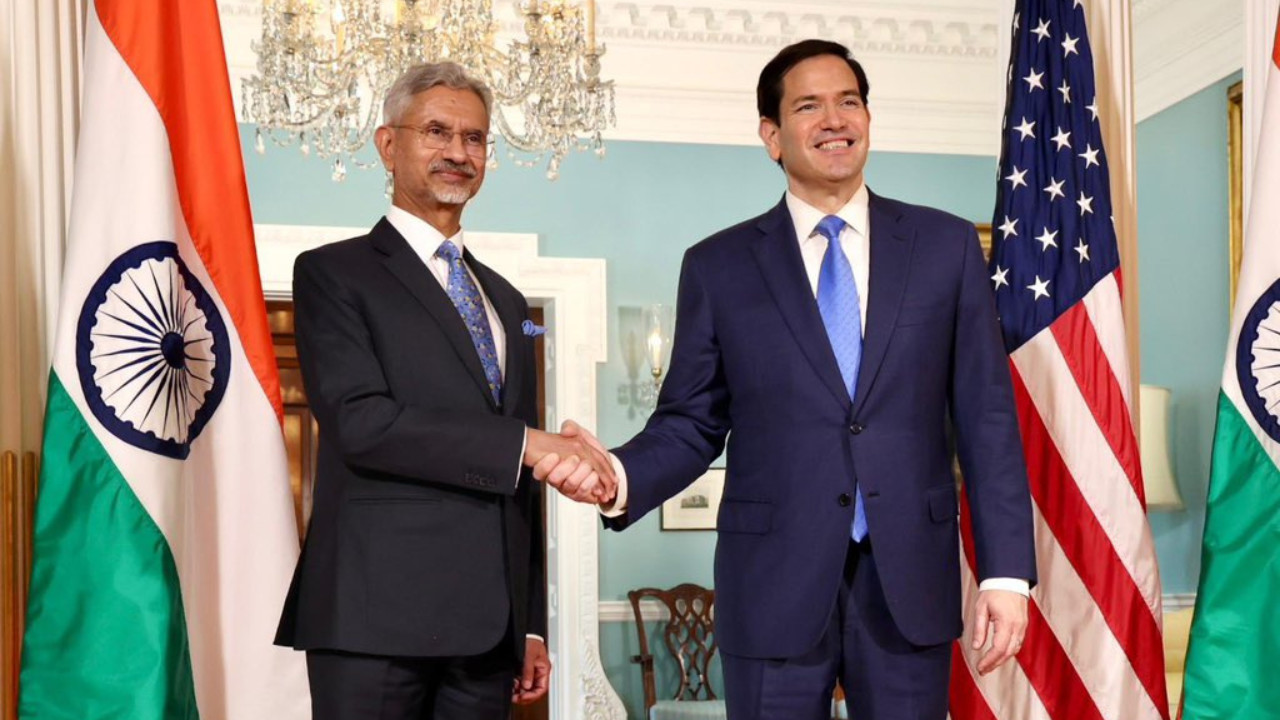
External Affairs Minister Subrahmanyam Jaishankar informed on Monday that he held a detailed telephone conversation with US Secretary of State Marco Rubio amid the military conflict in the Middle East. (Image X @dhairyam14)
New Delhi: External Affairs Minister Subrahmanyam Jaishankar informed on Monday that he held a detailed telephone conversation with US Secretary of State Marco Rubio amid the military conflict in the Middle East.
According to Jaishankar, the telephone conversation focused on discussing the ongoing conflict between the United States (US), Israel and Iran in the Middle East region and its wider economic fallout,
"Our discussions focused on the West Asia conflict and its impact on the international economy. We particularly spoke about energy security concerns. Agreed to remain in touch," the EAM said in a statement on social media.
Amidst the conflict in West Asia, the U.S. President has decided to halt attacks for a period of five days. Globally, this decision of his is being welcomed. However, Trump has now made it clear that if Iran does not yield through dialogue and reach an agreement, it will face continuous bombardment. On Monday, Trump emphasized that continuous contact is being maintained between the U.S. and Iran, and that both sides are agreeing on terms to end the conflict. Nevertheless, Iran's Foreign Ministry rejected these claims, stating that no negotiations are currently taking place. They allege that Trump is merely attempting to drive down prices in the energy market (oil prices).
President Trump—who just days ago heightened global tensions by issuing a 48-hour ultimatum to Iran—announced on Monday a five-day suspension of attacks and signaled the prospect of constructive dialogue with Iran. Speaking on Monday before departing from Florida for Memphis, Trump stated that his Special Envoy for the Middle East, Steve Witkoff, and his son-in-law, Jared Kushner, are engaged in discussions with the Iranian side, and that these talks are progressing in a positive direction.
He remarked, "All I am saying is that we are very close to an agreement. Our negotiations have been very, very robust. We shall have to see where they lead. We have reached a consensus on several key points. I would say that agreement has been reached on almost all issues... the negotiations have been very strong."
When asked whether he did not recognize the leadership of Mojtaba Khamenei—and, if so, with whom exactly he was negotiating within Iran—Trump replied that his envoys are speaking with an individual in Iran who commands respect within the country. He explicitly denied engaging in any form of dialogue with Mojtaba Khamenei.
During an interaction with journalists, U.S. President Donald Trump indicated that if Iran remains unwilling to reach an agreement even after these negotiations, the United States may proceed toward pursuing a regime change. Trump stated that if Iran does not yield, a new leader could be installed through a regime change similar to the one in Venezuela.
Trump—who had previously suggested he could have eliminated Iran's Supreme Leader during the very first day of attacks—stated that he has had no direct communication with Mojtaba Khamenei. However, he emphasized that he does not wish for any harm to befall Mojtaba. Furthermore, when asked about his 48-hour deadline, Trump claimed that the initiative for these talks had come from the Iranian side. Consequently, he had called off his attack.
It is worth noting that while Trump may be speaking of dialogue and peace, Iran has denied the existence of any such talks. Iran has stated that Trump is lying in an attempt to keep oil prices under control. Under no circumstances, they assert, is Iran at the negotiating table with the United States.
The situation in global politics is changing rapidly. Just 40 hours after threatening to wipe Iran off the map, US President Donald Trump is now providing details regarding talks with Iran. However, Iran has denied the existence of any such negotiations. On Monday—after halting attacks on Iran for a five-day period—when asked about control over the Strait of Hormuz, Trump replied, "Perhaps [it will be] me and the new Ayatollah—whoever the new Ayatollah may be."
Speaking to reporters aboard Air Force One in Florida, Trump stated that as soon as an agreement is reached with Iran, crude oil prices will drop sharply. Trump claimed that during recent discussions, "consensus on several major issues" has been reached between the United States and Iran. These talks have focused on Iran's nuclear program and the dismantling of its stockpile of enriched uranium. Trump remarked that if this five-day ceasefire proves successful, a resolution to the conflict in the Middle East could be found.
When asked—given that he does not recognize Mojtaba Khamenei's rule as legitimate—who exactly he is speaking to in Iran, Trump did not give a direct answer; instead, he simply stated that he is communicating with a highly respected individual within Iran. He said, "We have eliminated the first, second, and to a large extent, the third tiers of their [Iran's] leadership. But now, we are speaking with the person whom I consider to be the most respected figure and the true leader." He further added, "We want to ensure that no further uranium enrichment takes place, but we also want to secure the enriched uranium they currently possess."


Copyright © 2026 Top Indian News


