


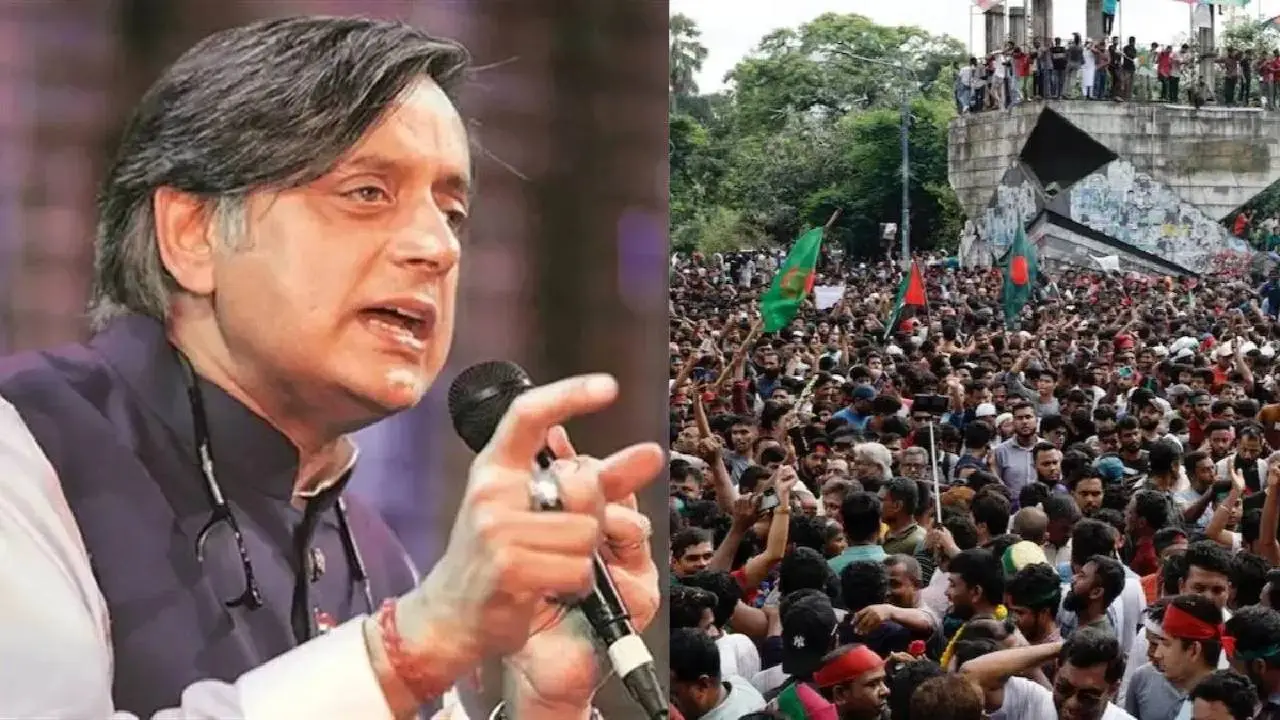
Bangladesh Political Crisis (Credit: OpenAI)
New Delhi: A parliamentary committee chaired by Shashi Tharoor has described the current situation in Bangladesh as India’s biggest strategic challenge since the 1971 Liberation War. The panel noted that while the country is not sliding into chaos, the developments demand careful handling. India faces a complex mix of political uncertainty and shifting alliances. The report underlined that complacency would be risky. Regional stability is directly linked to India’s security. The committee urged close monitoring. It called for strategic patience and preparedness.
The panel compared today’s situation with the events surrounding Bangladesh’s birth in 1971. It said that challenge involved humanitarian crises and the creation of a new nation. The current scenario is different but equally serious. It involves generational political change. The internal balance of power is shifting. India could face a strategic realignment in its eastern neighbourhood. The risk lies in gradual erosion, not sudden collapse. This makes the situation harder to manage.
The committee linked unrest to multiple overlapping factors. These include the decline of Sheikh Hasina’s Awami League dominance. It also pointed to the rise of Islamist political forces. External influences are growing stronger. Pakistan and China were named as key players. The panel said these trends together create uncertainty. None of them act in isolation. Their combined impact is the real concern.
China’s expanding footprint in Bangladesh drew special attention. The panel expressed concern over infrastructure and defence cooperation. Projects such as the expansion of Mongla port were highlighted. The Lalmonirhat airbase and a submarine facility at Pekua were also cited. The Pekua base can reportedly host eight submarines. Bangladesh currently operates only two. This mismatch raised strategic questions. India sees long-term implications in these developments.
The committee also flagged renewed engagement between Bangladesh and Pakistan. It noted the revival of Jamaat-e-Islami’s political registration. The party had earlier been banned. Its return allows participation in upcoming elections. The panel viewed this as a significant shift. It warned that such developments could alter Bangladesh’s political direction. This change may affect regional security equations. India is watching these signals closely.
The interim government in Bangladesh has banned the Awami League from contesting elections. The panel said this raises serious concerns. Continuous exclusion of a major party questions electoral fairness. The committee warned that future polls may lose credibility. Political imbalance could deepen unrest. Stable democracy requires inclusive participation. The ban could have long-term consequences.
The committee urged India to proceed with caution and strategic foresight. It said New Delhi must avoid overreaction but remain alert. Diplomatic engagement should continue. India should track political, military, and economic shifts together. The situation demands sustained attention, not short-term fixes. According to the panel, Bangladesh’s trajectory will shape India’s eastern security. The warning serves as a call for careful statecraft.


Copyright © 2026 Top Indian News


