


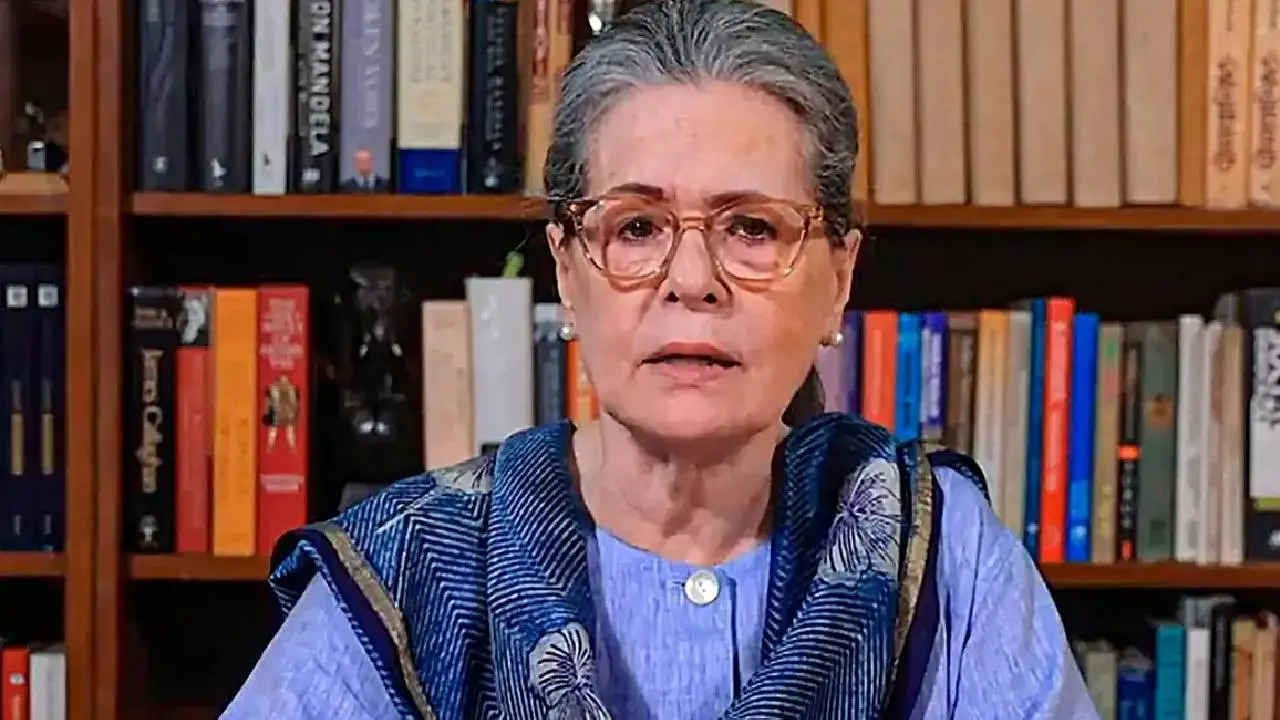
Sonia Gandh (Credit: OpenAI)
The ruling BJP strongly dismissed the claims made by senior Congress leader Sonia Gandhi on the VB-G RAM G Act, calling her arguments misleading and factually weak. The party said her criticism of the law replacing MGNREGA was based more on political narrative than legal or data-driven analysis. BJP leaders accused her of presenting selective memories and ignoring the actual text and intent of the new legislation.
The controversy erupted after Sonia Gandhi wrote an article in The Hindu, alleging that the Modi government had bulldozed MGNREGA and attacked the livelihoods of farmers, labourers, and landless rural poor. She described the end of MGNREGA as a collective failure and urged citizens to unite to protect social security rights. The article quickly became a flashpoint in national politics.
BJP IT cell chief Amit Malviya issued a detailed rebuttal on X, stating that Gandhi’s article resembled a “flight of political imagination.” He alleged that she had not even read the VB-G RAM G Act. According to Malviya, her arguments were built on misinterpretation, selective recall, and outright falsehoods rather than serious engagement with the law.
Malviya challenged Gandhi’s portrayal of MGNREGA as a product of wide democratic consultation. He claimed the scheme was conceptualized and controlled by the National Advisory Council, an unelected body that functioned like a “super-cabinet.” He said the attempt to present this process as participatory democracy amounted to historical rewriting aimed at political advantage.
Rejecting claims that demand-based employment has been scrapped, the BJP said the legal right to work remains intact under the new law. Malviya explained that what has changed is the budgeting system, shifting from an open-ended model to a norm-based framework, which is standard across most government schemes. He emphasized that guaranteed workdays have increased from 100 to 125, not reduced.
Citing NABARD and MPCE data, Malviya argued that rural India has significantly changed. He said 80 percent of rural households reported higher consumption, over 42 percent reported increased income, and nearly 58 percent now depend fully on formal credit. According to him, MGNREGA now functions more as a fallback safety net rather than the backbone of rural livelihoods, making reform necessary.
Malviya dismissed allegations that the Centre is shifting financial burden onto states by moving from a 90:10 to a 60:40 funding model. He said MGNREGA was never fully funded by the Centre, as states already bore material costs, administrative expenses, and unemployment allowances. The new model, he argued, formalizes and rationalizes funding, making states equal partners rather than passive implementers. He concluded that the VB-G RAM G Act represents repair, not demolition, and reflects modernization rather than abandonment of welfare.


Copyright © 2026 Top Indian News


