Israel Greece Cyprus Alliance (Credit: OpenAI )
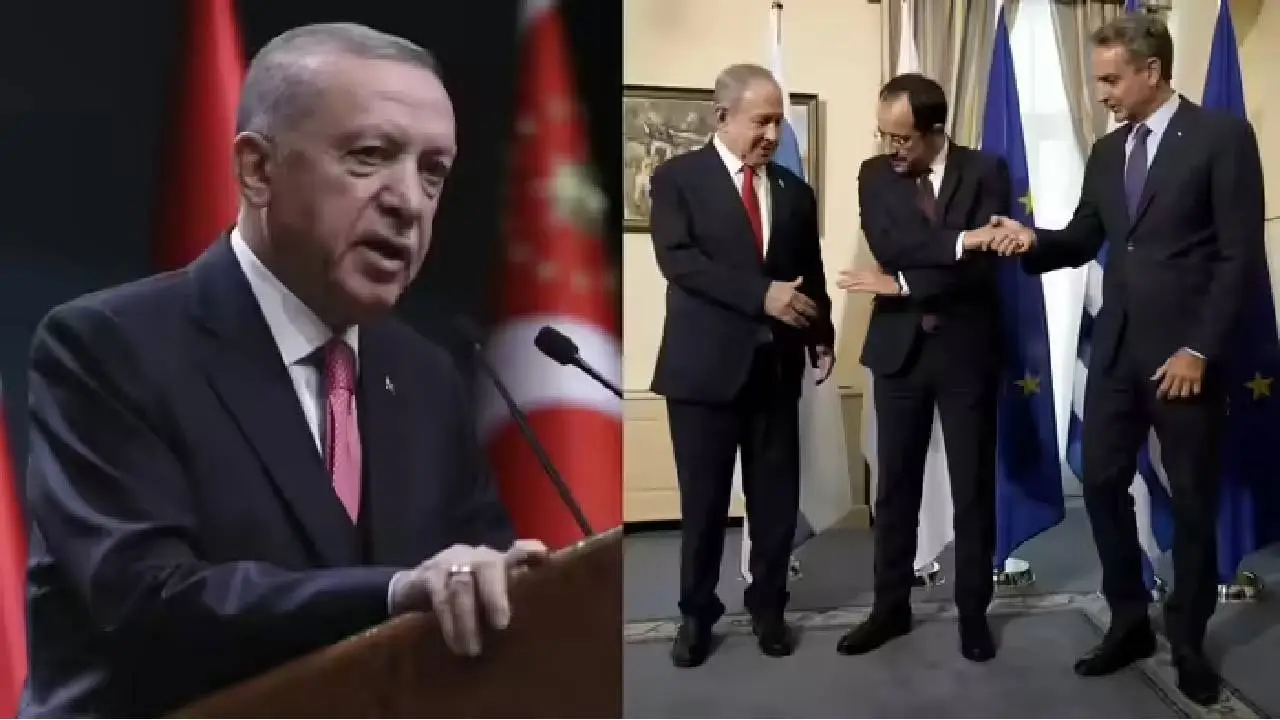
International News: Turkey’s rapid military expansion over recent years has raised alarm across the Eastern Mediterranean. Its assertive posture at sea, in the air, and across conflict zones has unsettled neighbouring states. In response, Israel, Greece, and Cyprus—three countries considered close strategic partners of India—are now discussing a coordinated military mechanism. Their goal is clear: to deter Turkey’s growing influence and signal collective readiness against sudden escalation.
According to reports, senior defence officials from Israel, Greece, and Cyprus have held meetings to explore forming a rapid-response force. This unit would not be permanent but designed for swift deployment during crises. It could operate across land, sea, or air, depending on the threat scenario. The proposal remains at a planning stage, but discussions have intensified amid rising regional tensions.
The proposed force is expected to comprise around 2,500 personnel. Reports suggest that Israel and Greece may each contribute roughly 1,000 troops, while Cyprus could provide around 500. The force would be modular, allowing quick mobilisation rather than maintaining a standing formation. This structure reflects modern military thinking focused on flexibility and speed rather than static deployments.
If implemented, the initiative would complicate Ankara’s strategic calculations. Turkish President Recep Tayyip Erdogan has heavily invested in expanding Turkey’s military capabilities, from drones to naval power. A coordinated front involving Israel, Greece, and Cyprus would limit Turkey’s room for manoeuvre in contested zones. It would also act as a deterrent against unilateral actions in the Eastern Mediterranean.
Turkey has been actively expanding its footprint in Syria, including deploying air-defence systems capable of targeting aircraft and missiles. It is also exploring participation in multinational forces near Gaza. Additionally, Ankara is negotiating maritime agreements with rival governments in Libya. Such deals could grant Turkey significant leverage over key maritime zones in the northern and eastern Mediterranean, unsettling regional rivals.
Israel has steadily deepened military cooperation with Greece and Cyprus over the years. The three countries have conducted multiple joint and trilateral military exercises. Defence experts believe that even if a formal rapid-response force is delayed, these joint drills will continue. Such exercises enhance interoperability and send a strong strategic signal to Turkey and other regional actors.
The emerging coordination reflects a broader realignment in the Eastern Mediterranean. As Turkey projects power more aggressively, its rivals are choosing collective deterrence over isolated responses. For India, which maintains strong ties with Israel, Greece, and Cyprus, these developments underscore shifting alliances and evolving security dynamics. Whether or not the rapid-response force materialises, the message is unmistakable: Turkey’s rise is being met with organised resistance.


Copyright © 2026 Top Indian News