


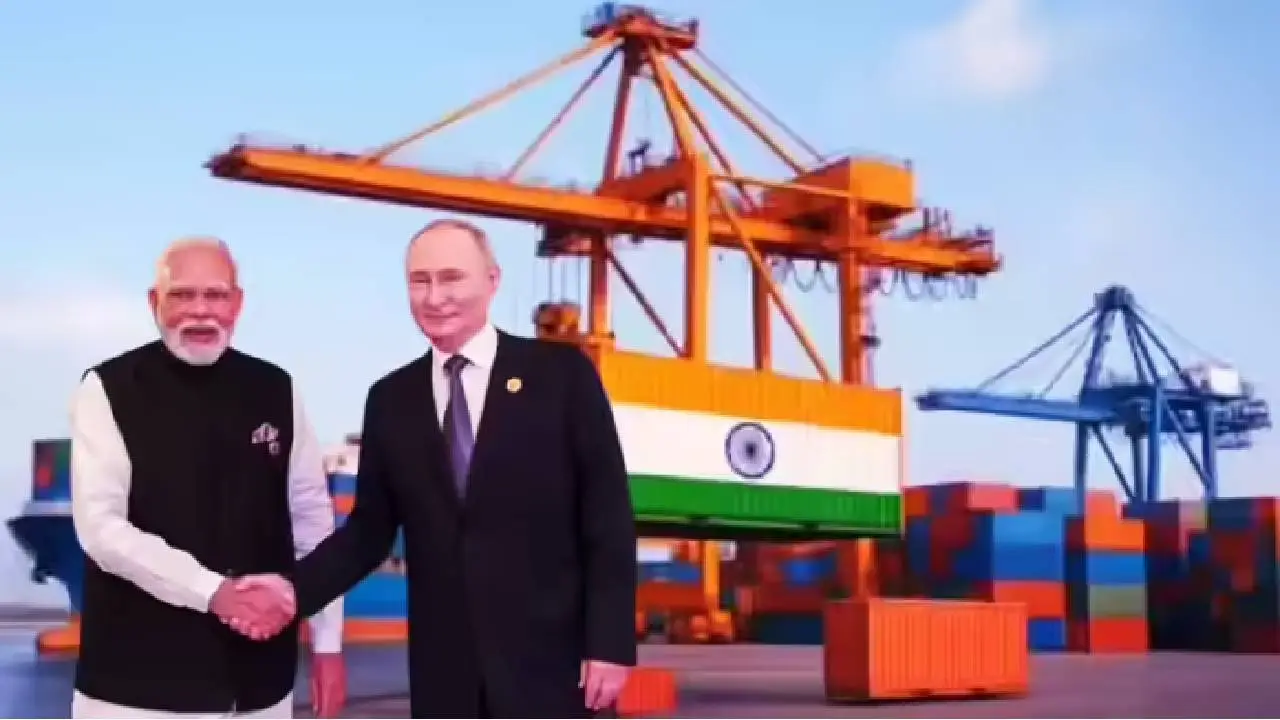
India Russia FTA (Credit: OpenAI )
Russia has openly expressed optimism about an early free trade agreement with India. Speaking in Moscow, Russian Deputy Prime Minister Alexey Overchuk said talks with India are progressing well. He noted that Indian products could soon become more visible in Russian markets. Overchuk described India as a fast-growing and friendly economy. He said both sides are eager to expand trade through formal agreements. This statement signals strong political backing from Moscow. It also reflects Russia’s intent to deepen economic ties with India.
India is negotiating a free trade agreement with the Eurasian Economic Union. The EAEU consists of Russia, Armenia, Belarus, Kazakhstan, and Kyrgyzstan. The proposed agreement would open a large regional market for Indian goods. It would reduce tariffs and simplify trade rules. Officials believe this could significantly increase bilateral trade volumes. For India, the deal offers access beyond Russia alone. It also strengthens India’s presence in Eurasia.
India’s Commerce and Industry Minister Piyush Goyal has confirmed that formal negotiations have begun. He said a structured 18-month roadmap has been prepared. The goal is to create new opportunities for Indian businesses. Special focus will be given to MSMEs, farmers, and fishermen. Indian exporters are expected to benefit from easier market access. The talks mark a strategic shift in India’s trade diplomacy. The government views this as a long-term growth driver.
The proposed India-EAEU FTA is being seen as a strategic counter to high tariffs imposed by the United States. Trade experts say India is diversifying its trade partnerships. Russia’s support strengthens India’s bargaining position globally. The deal could reduce India’s dependence on Western markets. It also signals India’s intent to pursue independent trade policies. Analysts believe Washington may view this development with concern. The timing adds geopolitical significance.
India and Russia share a long-standing strategic partnership. Relations deepened after the 2000 Strategic Partnership Declaration. Cooperation spans defence, security, trade, science, and culture. In 2010, ties were upgraded to a “Special and Privileged Strategic Partnership” during President Vladimir Putin’s visit to India. Regular institutional dialogues ensure continuity. Despite global shifts, both countries have maintained close coordination. Economic cooperation remains a key pillar of this relationship.
Trade and economic cooperation is guided by the India-Russia Intergovernmental Commission on Trade, Economic, Scientific and Cultural Cooperation. Its 26th session was held in Moscow in August 2025. The meeting focused on removing tariff and non-tariff barriers. Logistics and connectivity challenges were also discussed. Both sides stressed smoother payment mechanisms. The early conclusion of the India-EAEU FTA was a key priority. These efforts aim to accelerate economic engagement.
India and Russia are targeting $100 billion in bilateral trade by 2030. They also aim for $50 billion in mutual investment by 2025. Trade has already seen rapid growth. In FY 2024–25, bilateral trade touched a record $68.7 billion. India exported $4.9 billion worth of goods, including pharmaceuticals and steel. Imports from Russia stood at $63.8 billion, led by crude oil and fertilizers. The proposed FTA could push these numbers even higher.



Copyright © 2026 Top Indian News