


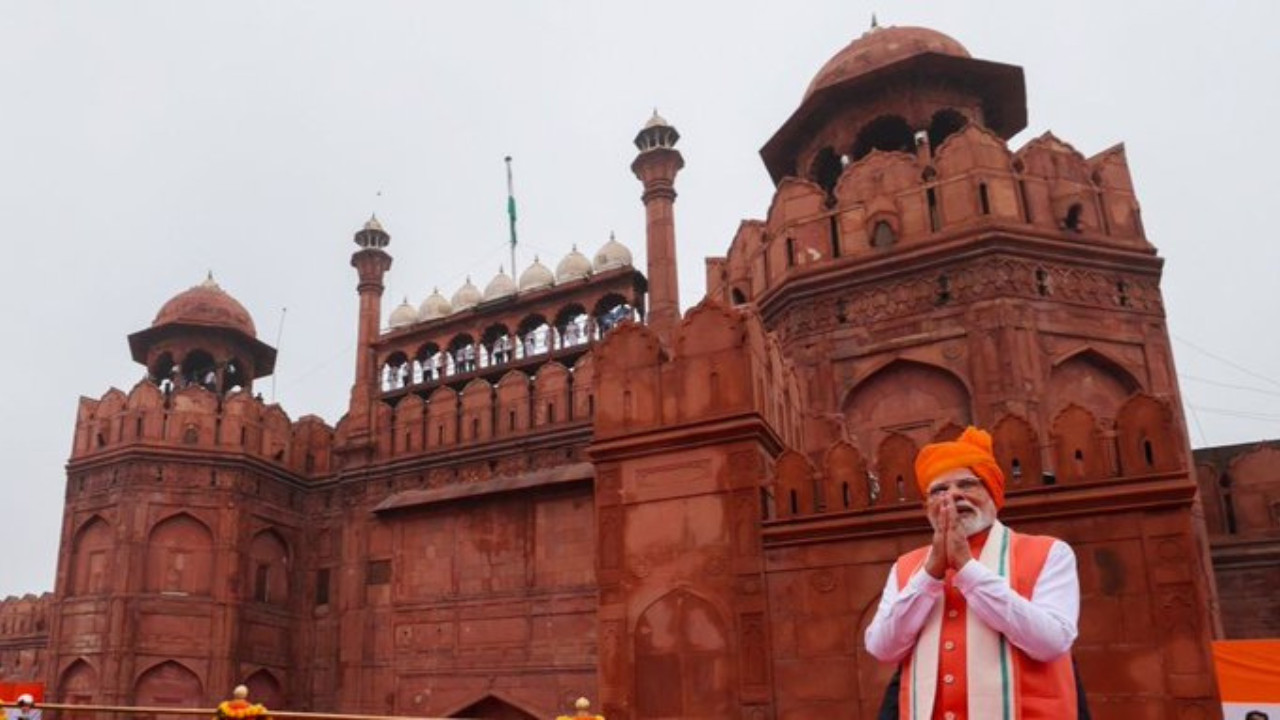
PM Narendra Modi has asserted on that the Indian economy performed exceptionally in 2025 and has outlined the benefits his reforms have brought for the common man (Image X @narendramodi)
New Delhi: Prime Minister Narendra Modi asserted on Tuesday that the year 2025 has proven to be a landmark year in India's journey of economic reforms, adding that the central government has prioritized the middle class and the common man in its policies.
Prime Minister Narendra Modi stated that India's growth story is based on values such as labour laws and trade agreements, as well as logistics, energy, market reforms, credibility, stability, and long-term confidence. PM Modi further added that India has boarded the reform express. The main engine of this reform express is India's demography, our young generation, and the indomitable spirit of our people.
“2025 will be remembered as a year for India when it focused on reforms as a continuous national mission, building on the ground covered over the past 11 years. We modernised institutions, simplified governance, and strengthened the foundations for long-term, inclusive growth," Pm Modi said in a post on social media.
“I have been telling many people that India has boarded the Reform Express. The primary engine of this Reform Express is India’s demography, our young generation and the indomitable spirit of our people,” PM Modi wrote.
He said that 2025 will be remembered as the year when India, building on the achievements of the past 11 years, focused on reforms as a continuous national mission. We modernized institutions, simplified governance, and strengthened the foundations for long-term, inclusive growth. He further added that we moved forward with unwavering resolve... with high ambition, rapid implementation, and profound transformation. The aim of these reforms has been to empower citizens to live lives of dignity, enable entrepreneurs to innovate with confidence, and allow institutions to function with clarity and trust. During this time, PM Modi provided examples of the reforms undertaken by the government.
- A simplified two-slab structure of 5% and 18% has been implemented (with a 40% slab for luxury and sin goods).
- The burden on families, small and medium enterprises, farmers, and labor-intensive sectors has been reduced.
- This aims to minimize disputes and ensure better compliance. This reform has boosted consumer confidence and demand. Sales have increased during the festive season.
For the first time, individuals with an income of up to ₹12 lakh per annum have been exempted from income tax.
The outdated Income Tax Act, 1961 has been replaced with the modern and simplified Income Tax Act, 2025.
These reforms are leading India towards a transparent, technology-driven tax administration.
- The definition of 'small companies' has been expanded to include firms with a turnover of up to ₹100 crore.
- This will reduce compliance burden and costs for thousands of companies.
- 100% Foreign Direct Investment in Insurance Reforms
- 100% FDI is now permitted in Indian insurance companies.
- This will increase insurance coverage and strengthen people's security.
- Increased competition will lead to better options and services.
The Securities Market Code Bill has been introduced in Parliament. This will improve governance standards at SEBI, enhance investor protection, reduce compliance burden, and enable a technology-driven market.
Savings will accrue from reduced compliance and overhead costs.
- Five landmark maritime laws passed in the Monsoon Session: Bill of Lading Act, 2025; Carriage of Goods Bill, 2025; Coastal Shipping Bill, 2025; Merchant Shipping Bill, 2025; and Indian Ports Bill, 2025.
- Simplified documentation, easier dispute resolution, and reduced logistics costs.
- Replaced outdated laws (1908, 1925, 1958).
- Hundreds of obsolete laws repealed.
- 71 Acts repealed through the Repealing and Amending Bill, 2025.
- Ease of Doing Business
- 22 QCOs on synthetic fibers, etc., repealed, 53 suspended.
- Apparel exports will increase, production costs will decrease, and consumer prices will fall.
- 29 old laws merged into four modern codes.
- Labour framework protects business and worker interests.
- Fair wages, timely payments, industrial relations, social security, safe workplaces.
- Increased women's participation, ESIC and EPFO coverage for unorganized workers.
- Diversified markets for Indian products: Trade agreements with New Zealand, Oman, and the UK.
- FTA with EFTA (Switzerland, Norway, Iceland, Liechtenstein) implemented.
- Increased investment, employment, and competitiveness.
- SHANTI Act is transformative in the clean energy journey.
- Opportunities for private sector participation, innovation, and skill development.
- Meeting energy demands of the AI era, peaceful use in health, agriculture, etc.
- Clean, resilient energy ecosystem.
- Rural Employment Guarantee Reforms
- Developed India - G Ram Ji Act, 2025: 100 days increased to 125 days.
- Strengthened rural infrastructure and livelihoods.
- Establishment of a single higher education regulator.
- Replacing UGC, AICTE, etc., with the Developed India Education Foundation.
- Promoting institutional autonomy, innovation, and research.
PM Modi concluded by saying that the significance of the 2025 reforms lies in their scope and ideology. The government has prioritized cooperation over control, and facilitation over regulation. The reforms were crafted with empathy, shaped through consultation, guided by data, and based on constitutional values. They move from a control-based to a trust-based economy, with the citizen at the center. These reforms will create a prosperous, self-reliant India.




Copyright © 2026 Top Indian News


