


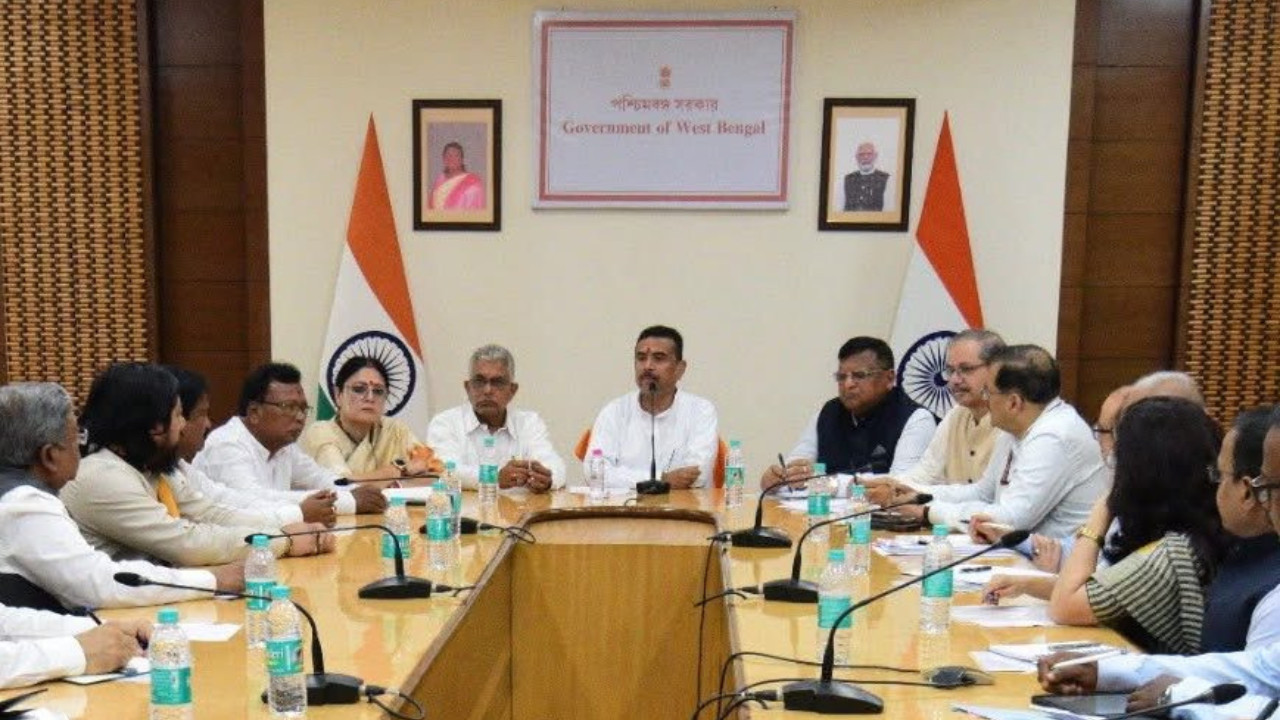
In West Bengal, Chief Minister Suvendu Adhikari made major announcements on Monday. (Image X @Tamal0401)
Kolkata: In West Bengal, Chief Minister Suvendu Adhikari made major announcements on Monday. One of these announcements concerns the Ayushman Bharat Scheme. This is a health insurance scheme launched by the Central Government. It is worth noting that Mamata Banerjee's TMC government had been consistently delaying the implementation of this central health scheme. Consequently, a large number of people in Bengal were deprived of healthcare facilities. Chief Minister Suvendu Adhikari made this announcement on Monday following the first cabinet meeting of Bengal's new government. Let us understand what the Ayushman Bharat Scheme is and how one can apply for it...
The Ayushman Bharat Pradhan Mantri Jan Arogya Yojana (PM-JAY) is an extension of the Centre's Ayushman Bharat initiative. It was launched by the Central Government in September 2018. The objective of this scheme was to provide healthcare services to economically weaker families. An Ayushman Card holder receives an insurance cover of ₹5 lakh per family. An individual holding an Ayushman Card can avail of cashless and paperless medical treatment at their preferred hospital. The funding for this scheme is provided jointly by the Central and State governments.
The coverage includes medical consultations, treatment and diagnostic tests, ICU and non-ICU services, medication and therapy, laboratory investigations, medical implants, accommodation facilities, expenses incurred up to three days prior to hospitalization, and follow-up care for 15 days after discharge from the hospital.
Conversely, there are certain items that are not covered under the Ayushman Bharat Scheme. These exclusions include the cost of outpatient treatment (OPD), cosmetic surgery, drug rehabilitation, fertility treatments, and personal medical care.
Individuals listed in the 2011 Socio-Economic Caste Census are eligible for this scheme. In urban areas, waste pickers, beggars, domestic workers, street vendors, hawkers, cobblers, construction and sanitation workers, plumbers, laborers, welders, painters, porters, security guards, handicraft workers, artists, tailors, transport workers, assistants, shop workers, delivery workers, and others are included in the list of people eligible for Ayushman Bharat.
In rural areas, the eligibility criteria for the Ayushman Bharat scheme differ. Under this scheme, families living in single-room *kaccha* (mud/temporary) houses are eligible. Also included are families with no members aged between 16 and 59 years; Scheduled Caste (SC) and Scheduled Tribe (ST) households; households consisting solely of female members; households containing a person with a disability; and landless families who earn their livelihood through manual labor.
Ayushman Bharat includes special provisions for senior citizens. Under these provisions, all citizens aged 70 and above—whether residing in rural or urban areas—are eligible. Citizens currently availing of government health facilities—such as ECHS, CGHS, or Ayushman CAPF—may choose to continue utilizing their existing health coverage or opt to switch to the Ayushman scheme. Furthermore, senior citizens enrolled in private health insurance plans or those who are beneficiaries of the ESI scheme are also eligible to avail of the benefits offered by the Ayushman scheme.
Certain documents are mandatory for obtaining an Ayushman Card. These include proof of age and identity (such as an Aadhaar Card or PAN Card), proof of address, a caste certificate, contact details (mobile number and email address), and an income certificate. The Ayushman Bharat and Annapurna Bhandar schemes are set to launch in West Bengal on June 1.
Women will also be granted the facility of free travel on buses. While addressing a rally prior to the West Bengal Assembly elections, Home Minister Amit Shah had announced that if the Bharatiya Janata Party (BJP) came to power, women would be provided with free travel on government buses starting June 1. This promise was also included in the party's manifesto.
Under the Annapurna Bhandar scheme for women, the BJP had pledged to implement a Direct Benefit Transfer (DBT) of ₹3,000 starting June 1. The BJP made this major electoral promise to counter the ₹1,500 DBT provided under the TMC's 'Lakshmi Bhandar' scheme. The party had stated its intention to double this financial assistance. Currently, work is underway regarding the procedures and regulations for the scheme; however, the government has, in principle, decided to implement it. Suvendu Adhikari has also clarified that no existing social welfare schemes will be discontinued.


Copyright © 2026 Top Indian News


