


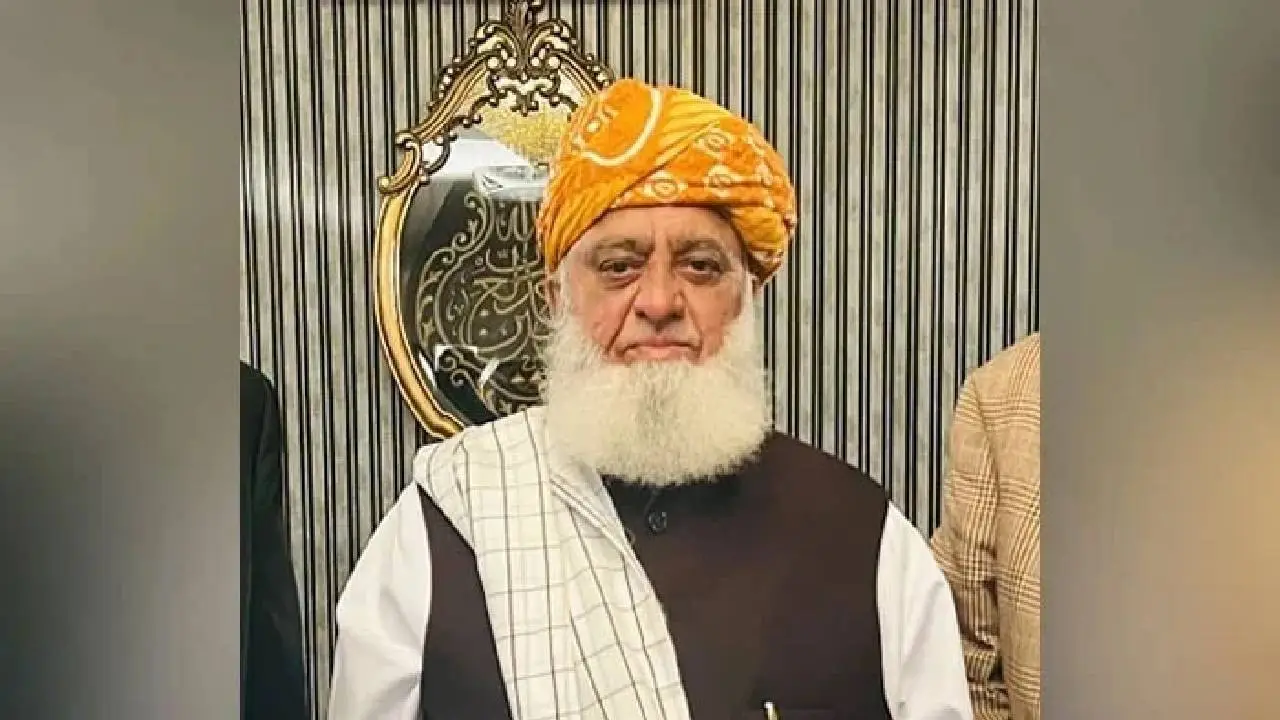
Maulana Fazlur Rehman (Credit: OpenAI)
Pakistan witnessed a rare moment of internal dissent when senior religious and political leader Maulana Fazlur Rehman openly questioned the military’s narrative. Speaking at a public gathering in Karachi’s Lyari area, he accused the government and the army of following double standards. His remarks directly challenged the justification Pakistan gives for its actions in Afghanistan while objecting to India’s counter-terror strikes. The statement immediately sparked political and security debates across the country.
Addressing the gathering, Maulana asked why Pakistan considers its own operations in Afghanistan legitimate but labels India’s strikes inside Pakistan as wrong. He said if Islamabad defends attacks on its enemies across borders, it cannot logically oppose India’s action against terror camps in Bahawalpur and Muridke. According to him, this contradiction exposes the weakness of Pakistan’s official position. His comments were seen as indirectly validating India’s stance on cross-border terrorism.
The statement was delivered during an all-party, multi-faith conference organised under the banner of Majlis Ittehad-e-Ummat Pakistan. Lyari, a politically sensitive area of Karachi, has symbolic importance in Pakistan’s public discourse. Coming from this platform, the remarks carried more weight than a routine political comment. Observers say such direct criticism from a senior religious leader is uncommon in Pakistan’s tightly controlled political environment.
Without naming individuals directly in every instance, Maulana’s remarks were clearly aimed at the army leadership led by Asim Munir. He accused the military establishment of selective morality in matters of national security. Analysts say this public challenge puts pressure on the army’s long-standing control over Pakistan’s foreign and security policy. It also reflects growing cracks between civilian leaders, religious parties and the military.
Maulana’s remarks come at a time when Pakistan’s Afghanistan policy is already under scrutiny. He has consistently criticised Islamabad’s handling of relations with Kabul. During heightened tensions between the two countries in October, he even offered to mediate between Pakistan and Afghanistan. His comments suggest that Pakistan’s internal consensus on regional security is weakening.
Maulana Fazlur Rehman is one of Pakistan’s most influential religious-political figures. He leads Jamiat Ulema-e-Islam (F) and is the son of former chief minister Mufti Mahmood. Notably, he is the only Pakistani political leader known to have met Taliban supreme leader Sheikh Hibatullah. His influence within Afghan Taliban circles is widely acknowledged. This background gives his statements strategic significance beyond domestic politics.
The Lyari speech has not only stirred Pakistan’s internal politics but also reopened debates on regional security and terrorism narratives. By questioning the army’s logic, Maulana has amplified criticism that Pakistan applies different standards depending on the actor involved. Analysts believe such statements could weaken Islamabad’s diplomatic arguments internationally. The episode signals rising internal pressure on Pakistan’s military establishment, with its own leaders now publicly questioning its core narratives.


Copyright © 2026 Top Indian News


