


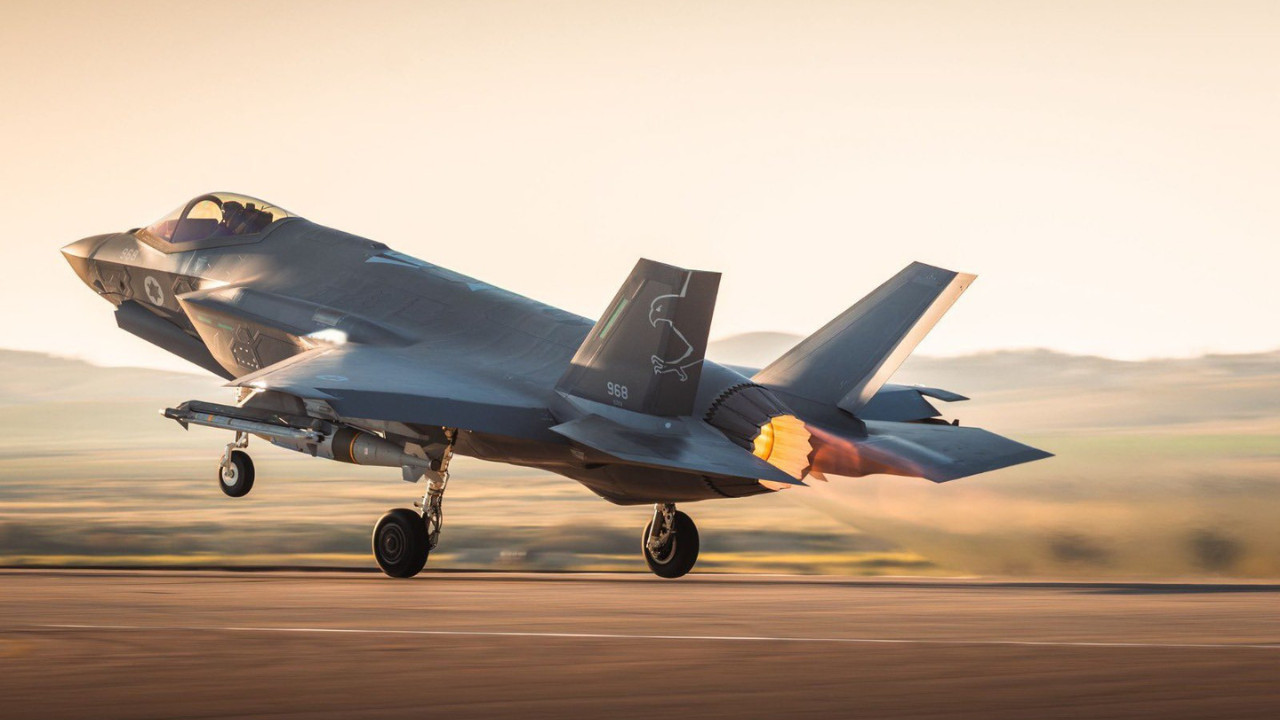
Iran has stunned the world by attacking a US F-35 fighter jet. (Image X @VivekSi85847001)
Beijing: Iran has stunned the world by attacking a U.S. F-35 fighter jet. This marks the first time that any nation has targeted an F-35 fighter jet, an aircraft equipped with stealth technology. The United States claims that no radar system in the world is capable of detecting the F-35 fighter jet. However, the U.S. itself has recently confirmed Iran's claim regarding the attack on the F-35.
The US Central Command reported that on Thursday, an F-35 was forced to make an emergency landing while conducting a combat mission over Iran. In light of this, Chinese experts have offered insights into how Iran managed to target the U.S. F-35 fighter jet—an aircraft previously considered impenetrable.
Speaking to the South China Morning Post, Yu Gang—a retired Colonel in the People's Liberation Army (PLA) and a military commentator—stated that the U.S. F-35 likely sustained only "minor damage." Consequently, he noted, "some of its basic operational capabilities likely remained intact." Citing infrared imagery of the attack released by Tehran, he speculated that the damage was unlikely to have been caused by ground-based artillery fire.
Yu further pointed out that the very fact that the F-35 fighter jet was able to execute an emergency landing suggests that it was not targeted by a conventional air defense system—such as the Russian-made S-300. He explained, "Had it been a familiar air defense system, it would have utilized radar guidance rather than infrared guidance. Furthermore, missiles launched by such systems are typically extremely powerful; if one were to strike an aircraft, that aircraft would generally not be able to return." He further stated, “My assessment is that the missile that targeted the F-35 was likely a modified air-to-air missile utilizing an infrared-guided seeker.”
According to reports, Iran imported R-27T air-to-air missiles from Russia in the 1990s—at the same time it acquired Russian MiG-29 fighter jets. The R-27T has a diameter of 0.23 meters (0.75 feet), which is quite small, and its explosive power is relatively low; however, its speed can reach up to Mach 5—faster than many stealth fighters. According to Yue, the F-35’s advanced stealth capabilities are primarily designed to counter electromagnetic radar detection; however, its stealth effectiveness is weaker against infrared detection via EO/IR systems, as these systems detect the heat signature generated by the aircraft's movement.
The R-27 is a Russian-made medium-to-long-range air-to-air missile. The Indian Air Force primarily employs the R-27 missile on its Su-30MKI fighter aircraft. The R-27 is a 'Beyond-Visual-Range' (BVR) missile, capable of striking targets beyond the line of sight. India has procured several hundred R-27 missiles, a purchase involving an expenditure of crores of rupees. The Indian Air Force utilizes various variants of this missile, including the infrared-homing R-27ET1 and the semi-active radar-homing R-27R1/ER1. Recently, India has repurposed its stockpile of aging R-27 missiles into an indigenous 'SAMAR-II' surface-to-air defense system.
Military analyst and former PLA instructor Song Zhongping also concurred that Iran may have utilized EO/IR sensors to detect the F-35—sensors that "do not emit electromagnetic waves and are entirely passive." Song stated, "It is difficult for the U.S. to detect this [system], which is why it could not be neutralized during previous attacks. Furthermore, the aircraft itself finds it difficult to determine that it is being tracked." He further added, "The F-35's 'low observability' does not imply that it is completely undetectable; that is a misconception... China possesses highly advanced electro-optical radars and a comprehensive system for detecting stealth targets, which utilizes arrays to provide early warning capabilities."
In a statement, U.S. Central Command spokesperson Captain Tim Hawkins said, "We are aware of reports indicating that a U.S. F-35 aircraft executed an emergency landing at a regional U.S. airbase after completing a combat mission over Iran." He added, "The aircraft landed safely, and the pilot is in stable condition. An investigation into this incident is underway." Although precise details and timelines have not been officially confirmed, this incident likely marks the first instance in which Iran has inflicted damage upon a U.S. combat aircraft since the commencement of hostilities following the joint U.S.-Israeli airstrikes on February 28.
The F-35 is widely regarded as one of the most powerful combat aircraft in the world. This is a fifth-generation multirole fighter jet. It was developed by Lockheed Martin. It features a distinctive design, internal weapons bays, and a coating of radar-absorbing materials. Consequently, the F-35 possesses greater stealth capabilities—the ability to remain hidden—compared to other fighter aircraft, and has a very low radar cross-section. Although it is not completely invisible, this jet has been specifically designed and developed to minimize its visibility. The F-35's The operation is conducted by 20 countries, most of which are allies of the United States.


Copyright © 2026 Top Indian News


