


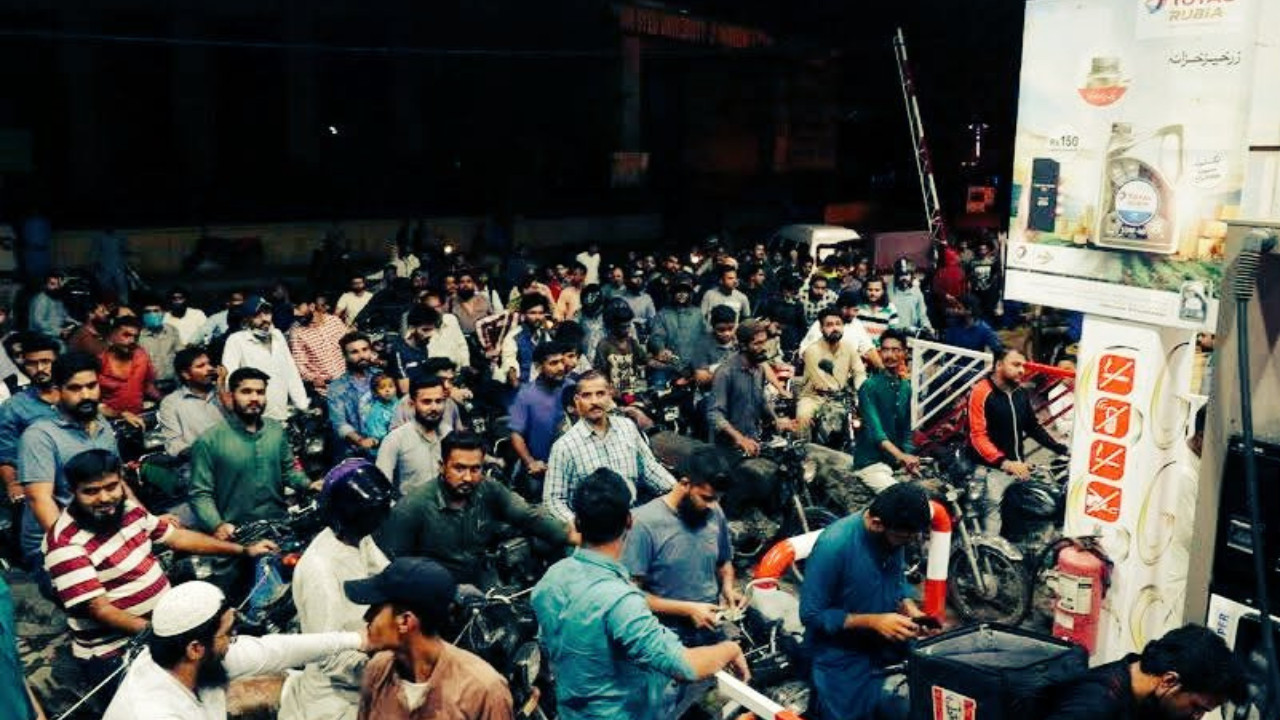
There's a global crude oil crisis triggered by the Middle East War between the US, Israel and Iran. (Image X @bilaltistic)
Lahore: There's a global crude oil crisis triggered by the Middle East War between the US, Israel and Iran. For Pakistan, the war with the Taliban forces of Afghanistan has exacerbated the situation. Amidst the conflict, countries like Kuwait and Qatar have announced a halt to oil and gas supplies.
Iran's halt to tanker traffic through the Strait of Hormuz has sent crude oil prices skyrocketing. The impact is already visible, particularly in countries like Pakistan and Bangladesh. In Pakistan, chaos has erupted on roads from Karachi to Lahore, and petrol pumps are crowded. The country's government is considering lifting restrictions imposed during the COVID-19 pandemic to conserve energy.
The US and Israel launched attacks on Iran on February 28th, sparking a war in the Middle East. This war between Iran and the US and Israel has directly impacted international crude oil prices. For the first time since 2022, Brent crude oil prices have surpassed $100. On Monday, crude oil prices surged by more than 25% to reach $110 per barrel. WTI crude prices also surged 24%, surpassing $112 per barrel.
This situation has arisen after major oil-producing countries like Qatar and Kuwait announced supply cuts due to the ongoing attacks during the US-Iran war. The disruption of oil tanker traffic in the Strait of Hormuz has added fuel to the fire. The Strait of Hormuz is a major sea route, carrying 20% of the world's oil consumption.
Pakistan is facing a severe fuel crisis after the government sharply increased petrol and diesel prices by PKR 55 per litre.The hike, announced due to rising global oil prices caused by escalating tensions in the Middle East, has triggered long queues and panic buying at petrol… pic.twitter.com/3x5NaKFNFJ
— himanshu singh (@96hhimanshu) March 6, 2026
The sharp rise in crude oil prices has already begun to impact many countries heavily dependent on oil imports. Pakistan is particularly dire. The government was forced to hastily raise petrol and diesel prices. After increasing fuel prices by more than 50 rupees, the price of petrol in Pakistan now stands at 336 rupees per liter, while the price of high-speed diesel has reached 321 Pakistani rupees per liter. Due to the fuel price hike, huge crowds were seen at petrol pumps in many cities, including Karachi and Lahore.
These measures failed to yield any significant improvement, and the Shahbaz Sharif government is now forced to reconsider the restrictions imposed during the COVID-19 pandemic to conserve energy. According to reports, the Pakistan government is preparing to launch a nationwide energy conservation strategy to reduce the demand for imported petroleum products and RLNG.
A report in Pakistani media outlet The Express Tribune states that a phased plan has been finalized, which will be reviewed in an emergency meeting chaired by Prime Minister Shahbaz Sharif. This plan has been formulated due to the potential for a widespread energy crisis amid the Middle East war, the blockage in the Strait of Hormuz, and rising geopolitical tensions.
Officials have proposed reinstating several energy-saving measures implemented during the COVID-19 pandemic. The report quoted officials as saying that this government strategy will be implemented in three phases, starting with energy-saving measures in the public sector.
What’s happening in Pakistan?
— Devansh Kumar (@BharatKaDevansh) March 6, 2026
Pakistan is witnessing long queues at petrol pumps as fears of a fuel crunch spread.
The ongoing Iran–Israel conflict and uncertainty around regional oil supply routes are raising concerns about energy availability. pic.twitter.com/3d18HWQfFI
Working from home and resuming online classes instead of in-office is proposed.
Government meetings may be conducted online, and attendance in government offices, except for the health sector, may be limited. Increasing the number of public holidays is also being considered during the first phase of reducing energy consumption. Adequate steps will be taken to curb hoarding and smuggling of petrol and diesel. Priority will be given to the supply of LNG, LPG, and natural gas to essential sectors.
The most significant issue is that these dire circumstances have arisen in Pakistan, despite the fact that last year the neighboring country was boasting about its oil reserves to the world. US President Donald Trump was also impressed by Pakistan's oil reserves and announced a deal. He stated that the US had signed a new agreement with Pakistan, under which both countries would work together to develop Pakistan's vast oil reserves. Donald Trump even said, "Who knows, one day Pakistan may be selling oil to India."
Pakistan's claims were based on a 2020 joint study between the country's Ministry of Energy and the now-defunct United States Agency for International Development (USAID). Reports suggest that Pakistan had discovered large oil and gas reserves in its territorial waters in the Arabian Sea in 2025, located in an offshore block off the coast of Karachi. At the time, some Pakistani media reports also claimed that significant oil and gas reserves could be found there. However, this was not considered a proven reserve. Now, amid the global crude oil crisis, Pakistan's worsening situation appears to be proving these claims to be false.


Copyright © 2026 Top Indian News


