


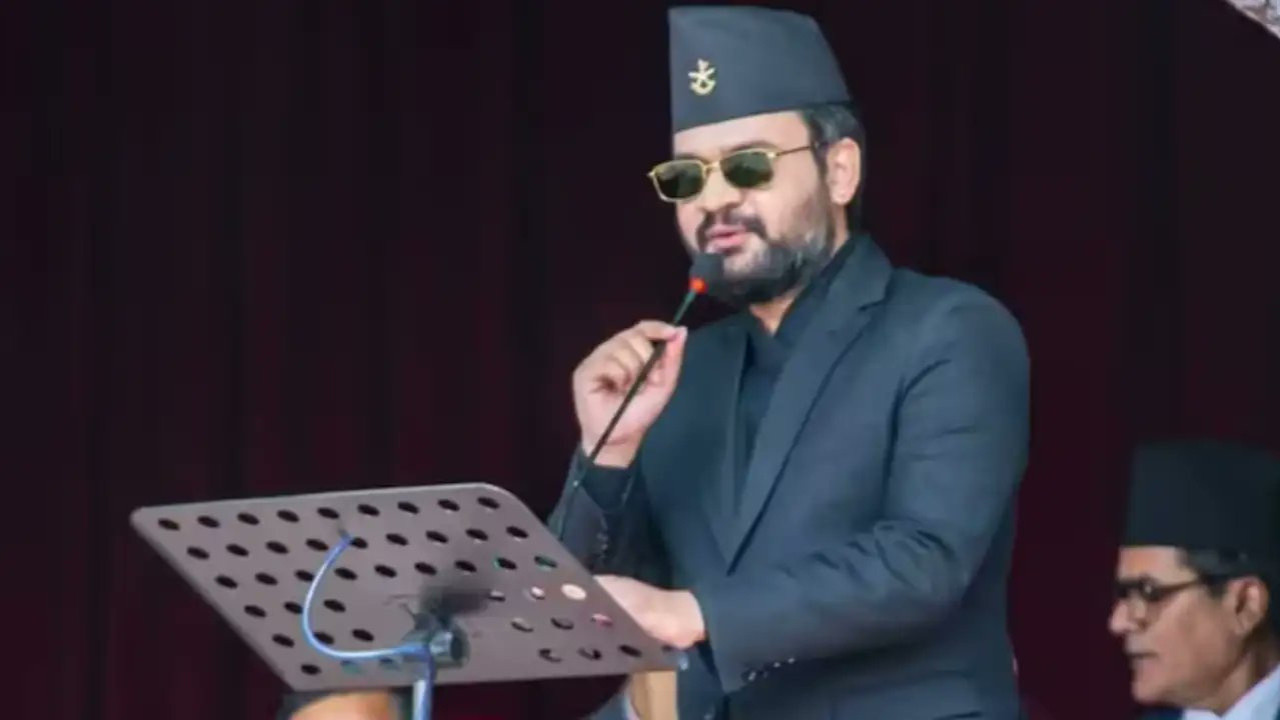
Nepal Prime Minister Balen Shah intends to uphold the tradition during his visit to India - his first foreign visit after assuming office. (Image X @ProfNoorul)
Kathmandu: Nepal Prime Minister Balen Shah intends to uphold the tradition during his visit to India - his first foreign visit after assuming office as the Prime Minister of Nepal. However, unlike his predecessors, Balen Shah does not wish to limit his interaction with the Indian Prime Minister to a mere ceremonial courtesy call; to this end, he has presented several conditions to New Delhi.
Confirming this, Nepal's Foreign Minister, Shishir Khanal, stated that officials from both India and Nepal are currently working on specific issues, and Balen Shah's visit to Delhi will take place only after these matters have been finalized.
The Nepali Foreign Minister confirmed that he has received an invitation from Indian Prime Minister Narendra Modi to visit India—an invitation he has accepted—but emphasized that he seeks to engage with PM Modi in substantive, results-oriented discussions rather than just a formal meeting.
During the tenure of K.P. Sharma Oli, relations between Nepal and India deteriorated significantly. According to 'The Kathmandu Post', Nepal's new government appears keen on getting its relationship with New Delhi back on track. During Oli's term, bilateral relations became highly strained, and he came to be viewed in Delhi as "China's man". 'The Kathmandu Post' attributed this situation to Oli's obstinate attitude. Regarding Balen Shah's visit, the Foreign Minister stated that he wishes to travel to Delhi to discuss a range of issues, thereby ensuring that the meeting yields meaningful results. He seeks to engage with Modi on matters aimed at advancing India-Nepal relations and intends to hold discussions focused on bringing these initiatives to a concrete conclusion.
India's suspicion regarding Oli intensified further when he amended the Constitution to adopt a new national map that incorporated Kalapani, Limpiyadhura, and Lipulekh—territories that fall within India's jurisdiction. Oli also incited the Nepali public against India. Furthermore, he mocked India's national emblem and made dubious claims asserting that Lord Rama was born not in India, but in Nepal. However, Oli is now a figure of the past, and a new current has emerged in Nepali politics—one that must determine the nature of the relationship it wishes to forge with India.
Under the leadership of Balen Shah, the robust Rastriya Swatantra Party (RSP) government is now in power. Indeed, an atmosphere of optimism prevails in both capitals. Nevertheless, it will be challenging for Balen Shah to set aside the contentious issues that arose during Oli's tenure in order to move forward. For Balen Shah, renouncing claims over the three territories that Oli incorporated into the Nepali map would be tantamount to political suicide. He can, however, certainly choose to avoid broaching these issues altogether.
The difficulty, however, lies in the decision Balen Shah will make regarding the Lipulekh Pass—the tri-junction point shared by Nepal, India, and China. Both India and China have already announced the resumption of trade through this route. Prime Minister Shah will face pressure to, at the very least, raise this complex issue with India during his official visit. Nevertheless, most of the complexities plaguing India-Nepal relations are artificial rather than inherent; consequently, these issues can be resolved through strong political will.
Balen Shah could request an additional air route from India to facilitate easier air connectivity between Nepal and the rest of the world. Balen Shah could engage India in discussions to ensure that Nepal is included in future negotiations regarding trade conducted through the Lipulekh route. However, India's response to this proposal could be firm. Balen Shah must reassure New Delhi that his intentions regarding China are not directed against India. This constitutes a "red line" for India. He must offer India a credible assurance in this regard. For Balen Shah, doing so would be relatively easy, as he does not carry the burden of past political baggage. Furthermore, while making such assurances to India, he must also demonstrate to the Nepali public that he does not belong to the Indian camp. He will need to present a balanced foreign policy—a task that is likely to prove quite challenging for him.
If Balen Shah approaches the situation with sincere intentions and a commitment to Nepal's interests, he could receive a warm welcome in New Delhi. Balen Shah has, at the very least, the examples of the Maldives and Bangladesh before him. After adopting an anti-India stance for several months, both these nations were ultimately compelled to seek reconciliation with New Delhi. While the Maldives' Mohamed Muizzu owed his electoral victory to an "India Out" campaign, Balen Shah's triumph was fueled by the hopes and aspirations of Nepal's youth; consequently, he can present his own set of expectations before New Delhi. If he succeeds in doing so, history will cease to be the sole determinant of the future of Nepal-India relations.


Copyright © 2026 Top Indian News


