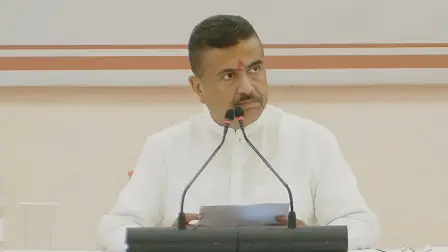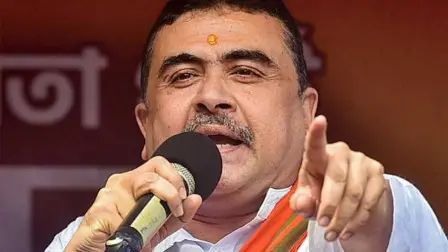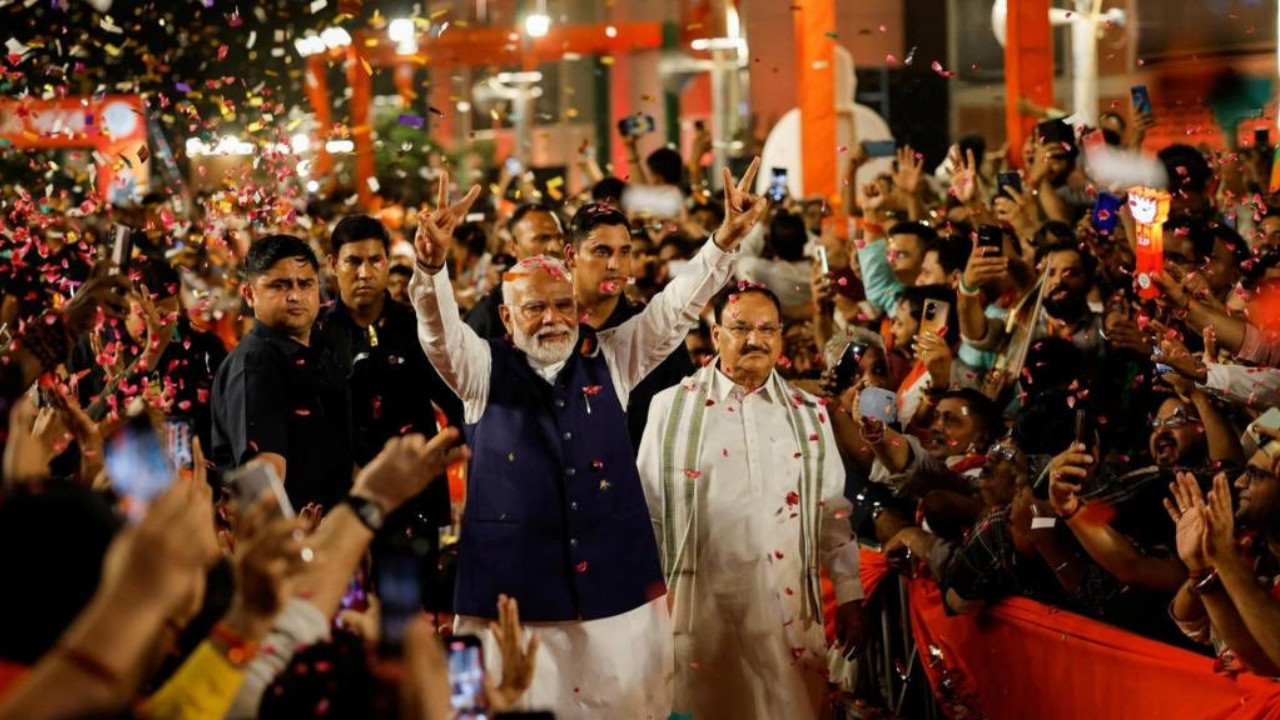
The Bharatiya Janata Party (BJP) has claimed a commanding victory in the West Bengal Assembly Elections 2026. (Image X @itsakhilnair)
Kolkata: The Bharatiya Janata Party (BJP) has claimed a commanding victory in the West Bengal Assembly Elections 2026. In the elections held for the state's 293 seats, the BJP won 207 constituencies—a figure significantly higher than the simple majority mark of 148. Meanwhile, outgoing Chief Minister Mamata Banerjee's party, the Trinamool Congress (TMC), won a mere 80 seats.
The TMC's 15-year-old rule thus drew to a close, and the BJP wrote a new chapter in the political history of West Bengal. The BJP's victory received extensive coverage in the international media. Global media outlets are characterizing this outcome as a major expansion of Prime Minister Narendra Modi's political influence and a significant blow to the opposition.
Reuters, the London-based news agency, reported that the BJP's victory is significant in many respects. The agency wrote, "On Monday, Indian Prime Minister Narendra Modi's party appears poised to secure a major victory in state elections. With this win, key policies such as the Uniform Civil Code and infrastructure development could gain further momentum. For the BJP, this also constitutes good news in the run-up to the 2029 general elections."
The agency noted that the opposition and some analysts attribute the BJP's success to factors such as the revision of voter lists in Bengal—a process that resulted in the exclusion of hundreds of thousands of people, particularly Muslims, from the electoral rolls. Opposition parties allege that a disproportionately high number of those excluded from the voter lists are their own supporters. However, the Election Commission has maintained that this process was conducted in strict accordance with established regulations.
The Reuters report further stated, "Analysts also suggest that the combination of Narendra Modi's personal popularity, his agenda for economic development, and a robust, Hindutva-centric political strategy is proving overwhelming for the opposition."
Citing Rahul Verma, a fellow at the Delhi-based think tank Centre for Policy Research, the agency wrote, "The BJP possesses a charismatic national leader; the party is highly organized; it enjoys a resource advantage that many other parties lack; and it articulates a clear ideological narrative—all of which are factors that help consolidate support among certain segments of the Hindu population."
The British broadcaster BBC headlined its report: "Modi's BJP Conquers Bengal—One of India's Toughest Political Strongholds."
The report observed, "For many years, the Indian state of West Bengal remained a notable exception to Narendra Modi's political dominance... The BJP's victory there on Monday is set to be counted among the most significant political triumphs of Modi's 12-year tenure."
According to the British broadcaster, a victory in this state—home to a population exceeding 100 million—will lend fresh momentum to Modi's Hindu nationalist agenda and complete the BJP's expansion across eastern India.
The German broadcaster DW (Deutsche Welle) has headlined its report: 'Narendra Modi claims victory in West Bengal elections.'
DW wrote, 'Prime Minister Narendra Modi's Hindu nationalist BJP party is on track to form a government in the state for the first time. Modi now has his sights set on strengthening his foothold in other opposition strongholds as well.'
DW gave prominence to Prime Minister Modi's statement. PM Modi described the victory in Bengal as a 'magnificent mandate.' The report stated, 'Prime Minister Narendra Modi's Hindu nationalist BJP party is poised to form a government in the state for the first time.'
The German media outlet also published photographs of celebrations by BJP workers, depicting them playing drums and scattering colored powder ('gulal') on the streets of Kolkata.
The report further noted, 'The BJP's lead is being interpreted more as a rejection of the Trinamool Congress. People were disgruntled with the TMC, and therefore they voted for the BJP; this should not be construed as absolute support for the BJP.'
Turkey's state-run news channel, TRT World, also published a report on the election results across five Indian states: West Bengal, Assam, Puducherry, Kerala, and Tamil Nadu. The channel wrote, 'The vote counting for elections in key Indian states is taking place amidst an ongoing controversy regarding allegations of names being removed from voter lists.'
Citing BJP Bengal chief Samik Bhattacharya, TRT World reported, 'This election was a vote of rejection. The people of the state desire change. The ruling Trinamool Congress is headed for defeat.'
The report also made mention of the deletion of names from voter lists under the SIR framework—specifically highlighting its impact on minorities—as well as allegations of violence during the elections.
The UAE-based news website, Gulf News, published numerous photographs capturing the celebrations surrounding the BJP's substantial lead in West Bengal. The website headlined its report: 'BJP takes the lead; TMC suffers a setback!' Gulf News wrote: "The BJP's years-long effort to gain a foothold in Bengal—one of India's most politically formidable states—finally appears to be bearing fruit. The party has crossed the majority mark in the 294-member Legislative Assembly, maintaining a lead in nearly 200 seats, and seems poised to form the government in the state for the very first time."
An analytical article has been published in 'Prothom Alo', a local Bangladeshi newspaper, titled: "West Bengal Elections: Not Just the State's, But the Future of the Indian Republic Is Also at Stake."
The article states: "This year's West Bengal Assembly elections will be remembered in the annals of Indian electoral history for two distinct reasons. First, the 'Special Intensive Revision' (SIR) of the voter rolls, which resulted in a large number of people being stripped of their right to vote. And second, the unprecedented deployment of central forces aimed at ensuring a violence-free election."
The article further observes that should the BJP emerge victorious in Bengal, it would mark a major milestone for the party. Such a victory would signify the BJP's conquest of a state that has, until now, been considered notoriously difficult to win (the other two being Tamil Nadu and Kerala). If this victory is indeed achieved, it will have been driven by Hindutva-based polarization. This would serve as proof that the Hindutva ideology of the 'Hindi Belt' has now taken deep root in the Bengali psyche as well. Bengalis have long been identified with a syncretic Hindu tradition.
The article further stated, "While a BJP victory could pave the way for large-scale industrialization in the state and open up avenues for central funding, it could simultaneously pose an existential threat to the Trinamool Congress."
The Bangladeshi newspaper noted that, lacking a strong ideological foundation—unlike the Left—the critical question remains: how long will the party be able to survive in the aftermath of an electoral defeat? Just as the Trinamool had successfully co-opted the Left's grassroots workers during the Singur-Nandigram agitation, would those very same workers defect to the BJP in the event of a defeat? Such a scenario could further expose the party's internal vulnerabilities.


Copyright © 2026 Top Indian News