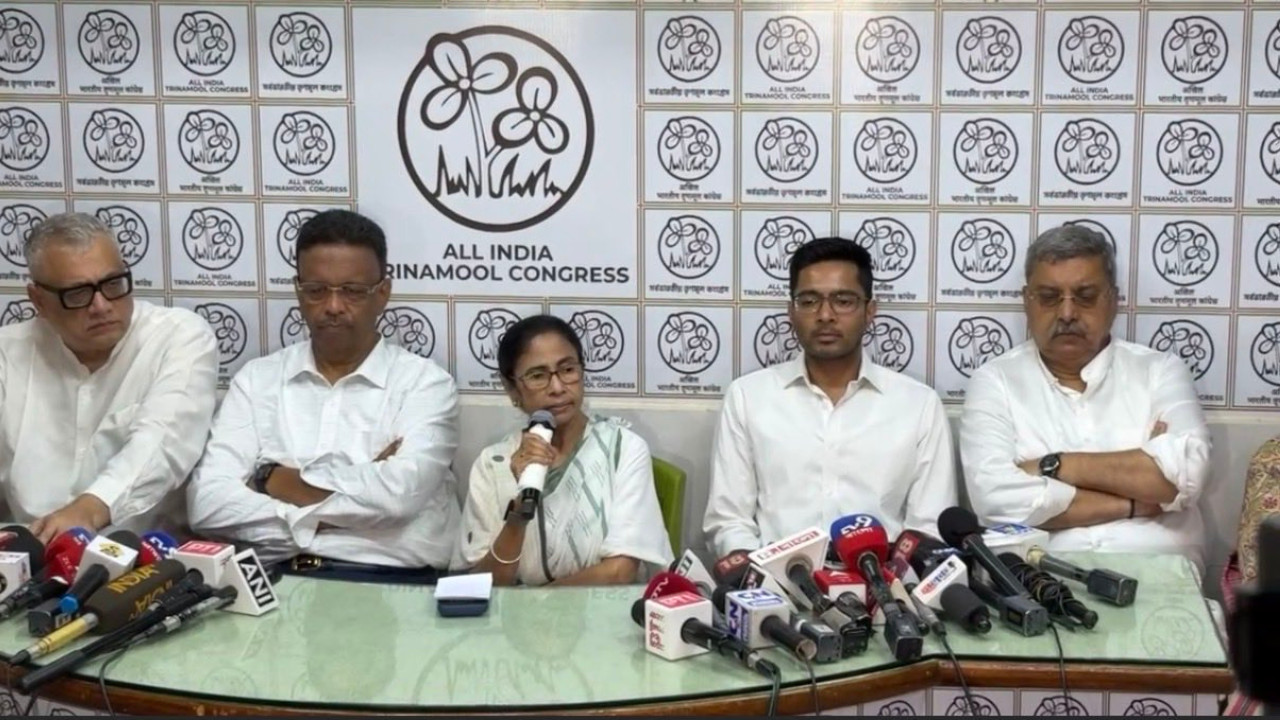
Major Crisis for Mamata Banerjee after resounding defeat to BJP in West Bengal Assembly Election 2026. (Image X @sayan2024)
Kolkata: Even after losing the elections in Bhabanipur and across Bengal, Mamata Banerjee remains unwilling to resign from the post of Chief Minister. The TMC chief alleges that the BJP rigged the elections by utilizing the Election Commission and central security forces. While the Trinamool Congress's numerical tally in the election results has declined, the BJP has not achieved a moral victory. In the Bengal elections, the TMC lost 8 percent of the vote share and 135 assembly seats. In this election, Mamata Banerjee also lost her grip on Singur—the very place where, 15 years ago, she had laid the foundation of her rise to power through a historic agitation. Following the greatest electoral defeat of her political career, the challenges facing her have only intensified.
Given the prevailing trends in West Bengal politics, an electoral defeat carries the persistent risk that the losing party will not only lose its popular mandate but also lose its grassroots workers on the ground. A similar phenomenon occurred following the TMC's victory in 2011; factions of Leftist supporters—those who once held the red flag—switched their allegiance and crossed over to the TMC camp. Following the BJP's victory on May 4th, TMC workers in several localities began showering saffron 'gulal' (colored powder) overnight.
The question now remains: will Mamata be able to salvage her party in the wake of such a massive defeat? Leading up to the 2026 elections, the TMC faced accusations of 'tolabazi' (extortion), 'cut money' (commissions), and corruption. On the ground, among the general public, corruption remained a major contentious issue throughout the TMC's tenure. The school recruitment scam further reinforced the perception that the ruling TMC was actively depriving people of employment opportunities. The infamous RG Kar Hospital rape case served as the final straw, completing the party's undoing.
The TMC government failed to effectively address the issues of 'tolabazi', 'cut money', and women's safety. The policy of minority appeasement also proved detrimental to the party, leading to a consolidation of the Hindu vote. The BJP secured 109 seats in the first phase of voting and 98 seats in the second phase.
Distracted by the "Mecca-Medina" rhetoric, the TMC was completely wiped out in eight districts. The TMC attempted to defuse the issue of unemployment by offering employment allowances; however, when weighed against the stark statistics of migration out of Bengal, this measure proved to be nothing more than a hollow "lollipop."
During the election campaign, Sayani Ghosh's song referencing *Kaaba-Madina*—along with statements made by Mamata Banerjee herself regarding Muslims—fueled polarization. The majority Hindu vote consolidated, and the BJP emerged victorious in both phases. The BJP completely swept the TMC out of a total of eight districts: Alipurduar, Jalpaiguri, Kalimpong, Darjeeling, Purulia, Bankura, Purba Bardhaman, and Jhargram. In Cooch Behar, the Trinamool Congress managed to secure only one seat. Out of the 152 seats contested in the first phase, the BJP won 109; in the second phase, it claimed 98 of the 141 declared seats.
The greatest threat facing Mamata Banerjee is the potential fragmentation of her party. Those who had shifted their allegiance to the TMC following the Left Front's ouster from power may now defect to the BJP. Furthermore, the faction responsible for booth management—characterized by its influence and strong-arm tactics—could also slip away from the TMC's fold. An even greater concern will be the challenge of preserving the party's strength within both the Legislative Assembly and Parliament.
In Maharashtra, the BJP fundamentally altered the political landscape by engineering splits within the Shiv Sena and the NCP. Consequently, the 'Thackeray' and 'Pawar' brands have now been significantly weakened in that state. Leaders from both parties—other than the founders—are currently leading large factions that have aligned themselves with the BJP. It is highly unlikely that the TMC in Bengal will remain immune to a similar fate. Ironically, it was Mamata Banerjee herself who initiated this very tradition following the previous election, by poaching MLAs from the BJP.
Currently, the Trinamool Congress is undergoing a phase of leadership transition. Abhishek Banerjee—the MP from Diamond Harbour and Mamata Banerjee's nephew—has effectively assumed the position of the party's second-in-command. Had the TMC secured a fourth consecutive term in power in Bengal, Abhishek would likely have firmly established himself as a prominent leader over the next five years. However, the dynamics of the game have now shifted. By choosing not to resign, the 71-year-old Mamata Banerjee has signaled her intent to maintain a combative stance; yet, sustaining such intensity over a full five-year term will be no easy feat. Abhishek Banerjee has never engaged in the politics of political struggle.
When the TMC assumes the role of the opposition in the Legislative Assembly, neither Mamata Banerjee nor Abhishek Banerjee will be present there. They will require legislators capable of challenging the BJP from within the Assembly. Furthermore, Mamata Banerjee could face a setback at the national level as well; the TMC—which has hitherto held the upper hand over the Congress—may find itself compelled to accept Rahul Gandhi's leadership.


Copyright © 2026 Top Indian News