


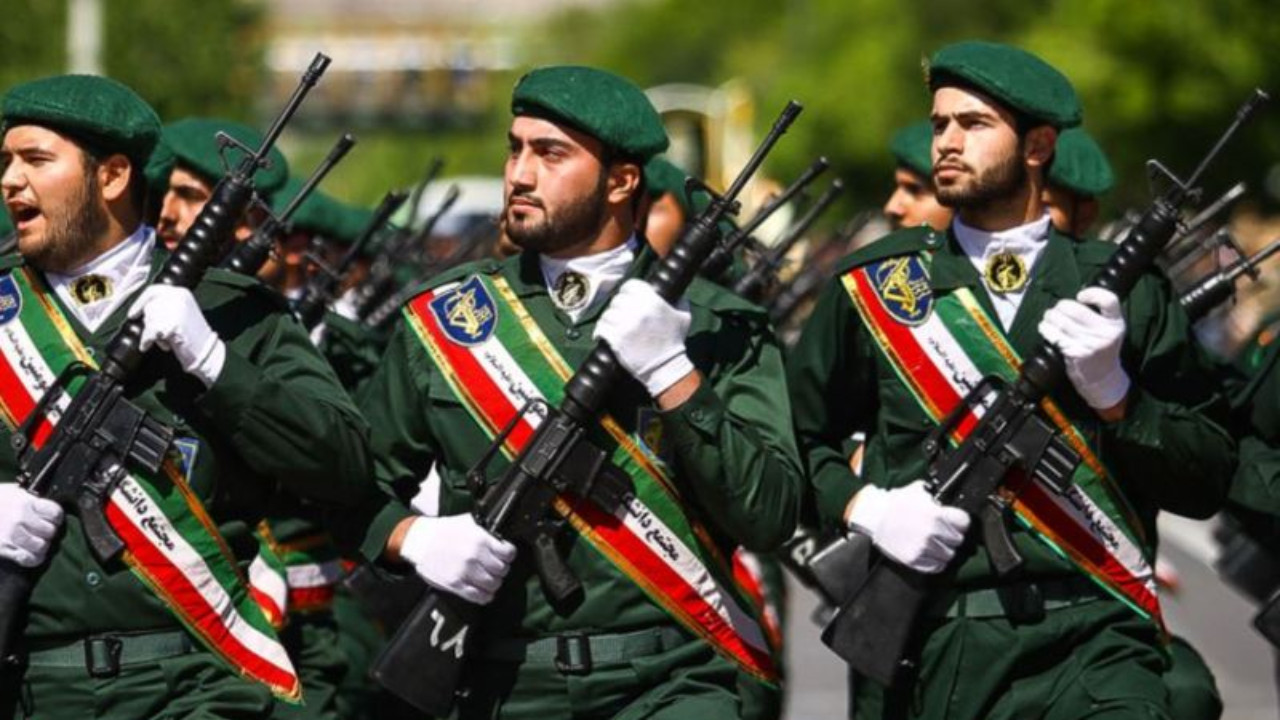
Despite heavy attacks by Israel and the United States, the Iranian regime remains unwilling to yield. (Image X @Iran_Focus)
Tehran: The conflict between Iran on one side, and the U.S. and Israel on the other, continues to drag on. Despite heavy attacks by Israel and the United States, the Iranian regime remains unwilling to yield. In this context, the question arises: who truly holds power within Iran? Following the death of Ali Khamenei in an airstrike at the outset of the war on February 28, his son, Mojtaba Khamenei, has been designated as the new Supreme Leader; however, he has thus far issued only a few written statements and has not yet appeared in public.
On one hand, U.S. President Donald Trump has signaled that he might halt attacks on Iran even without a formal agreement; on the other, Benjamin Netanyahu has vowed to crush Iran's "terrorist regime." Meanwhile, Iranian President Masoud Pezeshkian has stated that his country would be interested in ending the war if the United States were to provide "security guarantees."
However, the powers of the President within Iran's political system are limited. Iran is an "Islamic Theocracy," where, under the doctrine of *Velayat-e Faqih* (Guardianship of the Jurist), religious scholars govern the state. From the Supreme Leader down to the Revolutionary Guards (IRGC), power in Iran is fragmented across several powerful institutions. Let us examine how this power structure in Iran actually functions.
According to the Iranian Constitution, the Supreme Leader is the ultimate arbiter of the country's domestic and foreign policies. Currently, this office is held by Mojtaba Khamenei.
Authority over War and Peace: The Supreme Leader serves as the Commander-in-Chief of the armed forces. He alone possesses the authority to declare war or to ratify peace treaties.
Appointments: He holds the power to appoint and dismiss key officials, including the Head of the Judiciary, the Director of the state-run radio and television network, and the Commander of the powerful IRGC.
Guardian Council: He directly appoints half of the 12 members of the Guardian Council—a body responsible for overseeing and vetting the decisions made by the Parliament. The President: The Other Face of Governance
In Iran, the President serves as the Head of Government and holds the second-highest office—ranking only after the Supreme Leader—yet his powers remain limited.
Term of Office: The President may serve for a maximum of two four-year terms. He is responsible for implementing laws and presenting the national budget.
Limitations: While he selects his cabinet ministers, these appointments require approval from the Parliament. Furthermore, he can conduct diplomacy and govern only in accordance with the will of the Supreme Leader.
Powerful Institutions: Iran is home to several institutions that possess the authority to overturn any decision.
The Guardian Council (Council of Guardians): This body scrutinizes laws passed by the Parliament to ensure their compliance with Sharia law. To date, it has annulled approximately 40 percent of the laws passed by the Parliament. It is also this institution that determines who is eligible to run for public office.
The Assembly of Experts: Comprising 86 scholars, this body is responsible for electing the Supreme Leader. They convene once a year and periodically reaffirm the Supreme Leader's position.
The Expediency Council: This council serves to resolve disputes between the Parliament and the Guardian Council, and also acts as an advisory body to the Supreme Leader.
The IRGC's A Grip on the Military and the Economy: The Islamic Revolutionary Guard Corps (IRGC) operates distinctly from Iran's regular military and is significantly more powerful. It was established in 1979 with the mandate to safeguard the Revolution. It oversees Iran's nuclear program and exerts influence on foreign policy through its 'proxies' in Lebanon, Syria, Iraq, and Yemen. Moreover, the IRGC maintains a deep-seated control over major sectors of the Iranian economy, such as construction and telecommunications. It is widely regarded as Iran's most autonomous and powerful center of influence.
Judiciary and Intelligence Apparatus: Iran's Judiciary and Intelligence Ministry (MOIS) report directly to the Supreme Leader. Here, serious cases related to national security are adjudicated, and no appeals can be filed against these verdicts. Meanwhile, the Ministry of Intelligence (MOIS) investigates conspiracies both within and outside the country. Experts believe that it also plays a pivotal role in conducting operations abroad.
All in all, power in Iran does not rest solely in the hands of a single individual but is, rather, intertwined among various institutions. Although President Masoud Pezeshkian may be seeking a path toward peace, true power resides with Mojtaba Khamenei and the IRGC. Unless these powerful factions reach a consensus, an end to the conflict appears unlikely. Mojtaba's absence from the public eye for several weeks also suggests that a great deal is currently unfolding behind the scenes.


Copyright © 2026 Top Indian News


