


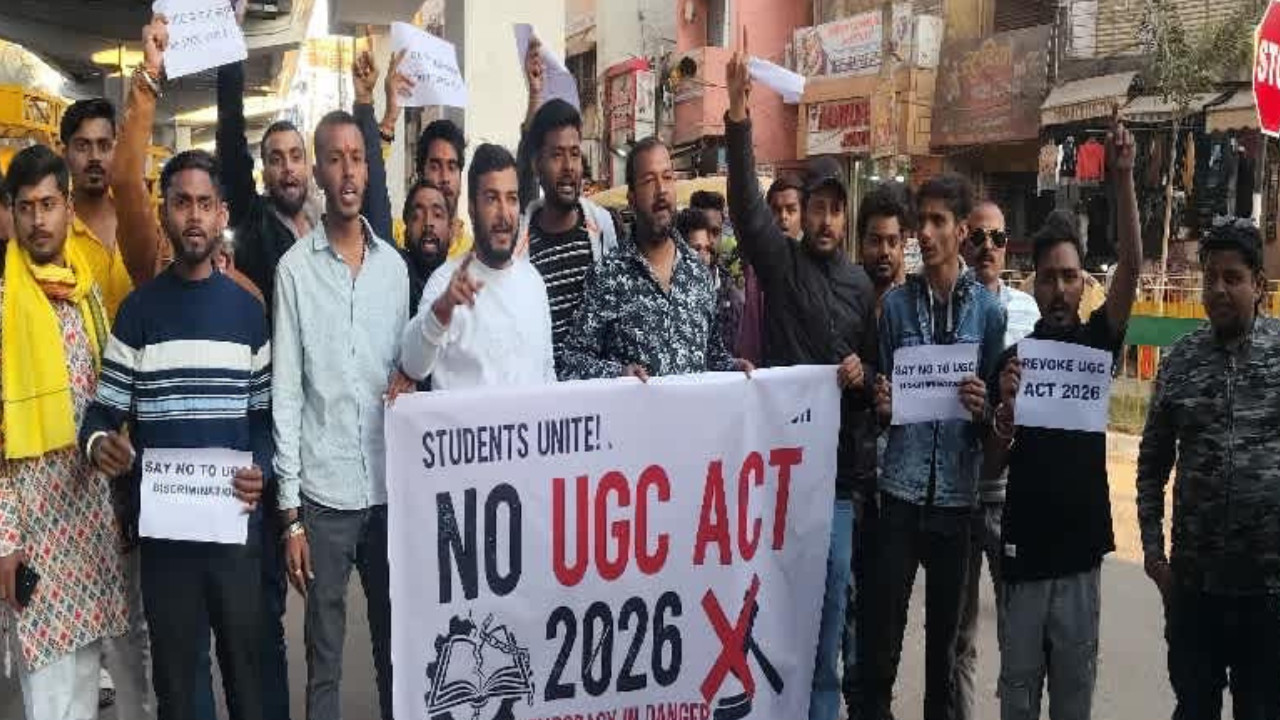
The UGC Rules 2026 have been implemented from January 15. (Image X @IndexOfUP)
New Delhi: The UGC Rules 2026 have been implemented from January 15. These rules apply to all universities, colleges, and higher education institutions in India. They outline provisions for the formation of Equal Opportunity Commissions in every institution. The rules aim to prevent discrimination against students from Scheduled Castes, Scheduled Tribes, and Other Backward Classes. Section 3(C) of these rules defines caste-based discrimination.
It states: "'Caste-based discrimination' means discrimination against members of Scheduled Castes, Scheduled Tribes, and Other Backward Classes solely on the basis of caste or tribe." This definition is currently facing objections.
Protests raging across the country over the UGC Guidelines, people are taking to the streets fighting for their children's future, meanwhile the BJP folks are saying this law is to your advantage😡
— Bhakt Prahlad🚩 (@RakeshKishore_l) January 24, 2026
Time to teach BIG Lesson to Anti GC BJP.#UGC_RollBack #ShameOnGCLeaders https://t.co/PsDlxmVaa5 pic.twitter.com/lkNSFdILSN
Organizations associated with the upper caste communities argue that while the UGC has provided protection against discrimination for SC, ST, and OBC students, it has said nothing about students from the general category. Furthermore, there are objections to the fact that there is no provision for action against those who file false complaints. Concerns are being raised that the lack of provisions against false complaints will lead to an increase in such cases, and this will become a tool to harass general category students.
Under the new rules, all institutions must establish an Equal Opportunity Centre. They must also create an equality helpline where anyone can file a complaint at any time. The rules also mention the formation of an inquiry committee and the possibility of handing over the case to the police if a cognizable offense is involved. There are objections to this as well, questioning how the police can enter university campuses. It is also important to read Section (E), which defines discrimination.
Students protest in front of Lucknow University against the UGC policies.
— We, the people of India (@India_Policy) January 27, 2026
This will become a hot issue in the upcoming UP election next yearpic.twitter.com/E1Av14SlEj
This section states: “‘Discrimination’ means any unfair, discriminatory, or biased treatment or any act, whether explicit or implicit, against any stakeholder on the basis of religion, race, caste, gender, place of birth, disability, or any combination thereof.” This includes any distinction, exclusion, restriction, or preference that has the purpose or effect of nullifying or impairing equal treatment in education, and, in particular, imposing conditions on any stakeholder or group of stakeholders that are contrary to human dignity.
Students protest in front of Lucknow University against the UGC policies.#UGC_RollBack pic.twitter.com/gBXpY4GFlA
— Megh Updates 🚨™ (@MeghUpdates) January 27, 2026
Some upper-caste organizations are also demanding why people from the general category cannot be given protection under this law. Their argument is that just as students from Scheduled Castes, Scheduled Tribes, and Other Backward Classes can be victims of discrimination, so can upper-caste students. Therefore, they should also have the same right to complain about discrimination against them. In addition, there is a demand for provisions for penalties or other action against those who file false complaints. Thus, a section of upper-caste individuals has a major objection to the provisions regarding the definition of caste-based discrimination.


Copyright © 2026 Top Indian News


