


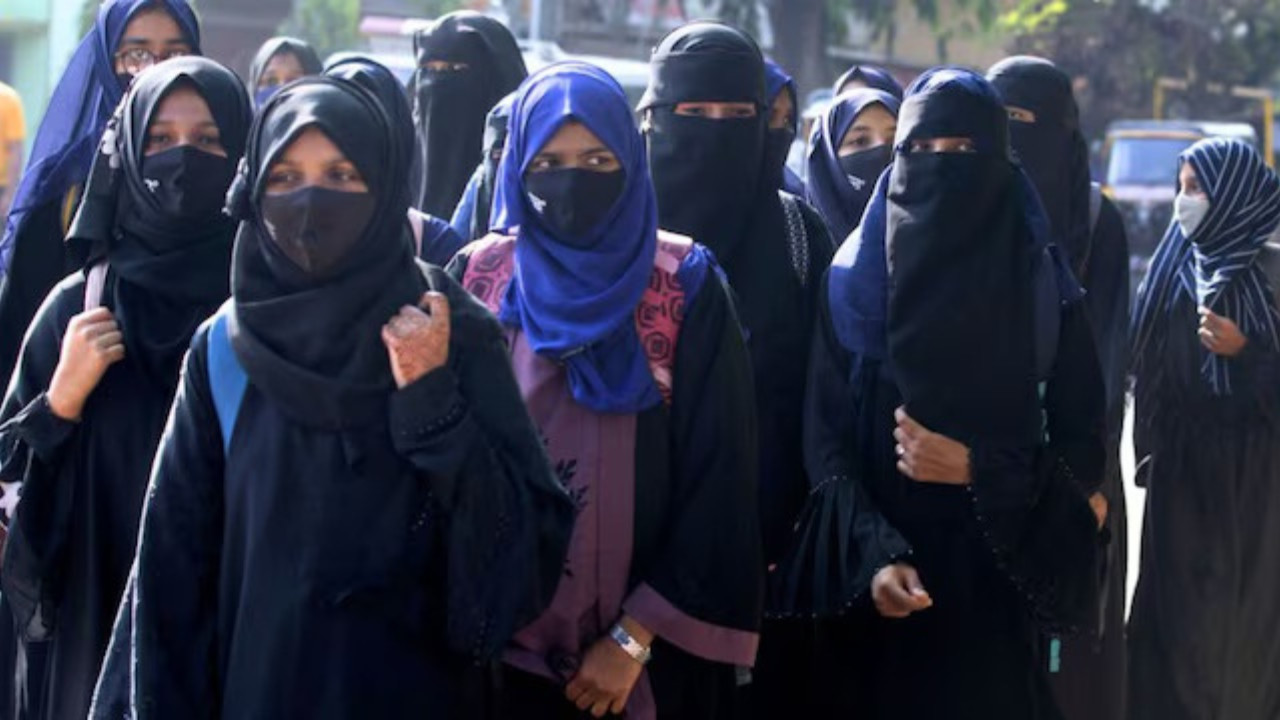
The Congress government in Karnataka decided on Wednesday to withdraw, with immediate effect, the 'Hijab Policy' previously enforced in educational institutions. (Image X @sanjoychakra)
Bengaluru: The Congress government in Karnataka decided on Wednesday to withdraw, with immediate effect, the 'Hijab Policy' previously enforced in educational institutions. The government, led by Chief Minister Siddaramaiah, has rescinded the order issued on February 5, 2022—an order that had sparked a nationwide political and legal controversy regarding the wearing of the hijab in educational institutions.
Following the hijab controversy, the previous BJP government had implemented a dress code in educational institutions on February 5, 2022. According to the new notification, students are now permitted to wear limited community-specific, traditional, and religious symbols alongside their prescribed school uniforms. As per the new notification, the uniform system will continue to remain in force as before across all government schools, government-aided educational institutions, private educational institutions, and pre-university colleges in Karnataka.
However, students will now be allowed to wear limited community-specific, traditional, and religious symbols in conjunction with their prescribed uniforms. The Karnataka government has clarified that these symbols must not undermine the fundamental purpose of the uniform. The symbols permitted by the government include the hijab (headscarf), *Janeyu* (sacred thread), *Shivadhara*, *Rudraksha*, and *Sharavastra*. Furthermore, other traditional and community-specific symbols have also been permitted, provided they do not compromise discipline, security, or the identification of students.
In its notification, the Siddaramaiah government has explicitly clarified that saffron shawls will not be permitted within educational institutions, as they are not categorized as religious symbols—unlike the *Janeyu*, which has been permitted. The order states that no student shall be denied entry into a school, classroom, examination hall, or academic activity solely on the grounds of wearing a traditional or religious symbol. The government has also affirmed that no student can be compelled to either wear or refrain from wearing such symbols. However, specific dress code regulations applicable at the national and state levels may be enforced during examinations. To ensure that the implementation of the new policy is free from any form of discrimination based on religion or community, the government has directed all schools and colleges to enforce the rules in a secular, equitable, and impartial manner. The School Development and Monitoring Committees (SDMCs), College Development Committees (CDCs), and the heads of educational institutions have been asked to ensure that no student faces discrimination or humiliating treatment regarding their attire. Furthermore, it has been stipulated that while discipline must be maintained within the institutions, no student should be deprived of their education.
The government has also clarified that, following this new order, all previous circulars, directives, resolutions, or institutional regulations shall be deemed invalid. The Commissioner of the State Department of School Education and Literacy and the Director of the Department of Pre-University Education have been directed to ensure the implementation of this order across all institutions. It is worth noting that, following the hijab controversy in 2022, school and college administrations were granted the authority to enforce uniform codes. Subsequently, in several government educational institutions, Muslim female students arriving in hijabs were denied entry into classrooms. In protest against this, many Hindu students began attending classes wearing saffron shawls, a development that further escalated the controversy across the state.


Copyright © 2026 Top Indian News


