


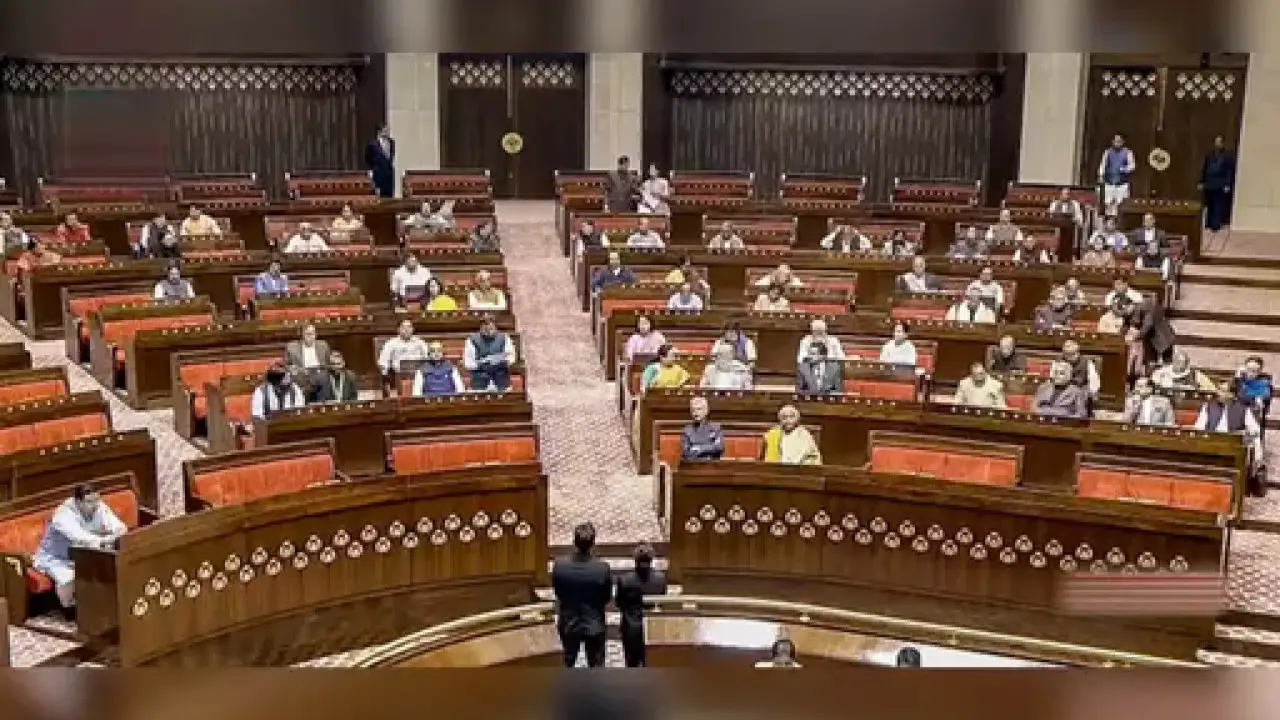
Rajya Sabha election 2026 results: Setback for Opposition in Bihar, BJP wins big in Odisha (X)
New Delhi: The results of Rajya Sabha elections for 37 seats have given a lot of tension to the opposition parties, Congress, Rashtriya Janata Dal (RJD) and Biju Janata Dal (BJD). The elections were held on Monday to fill 37 seats across 10 states. While many candidates won unopposed, voting was required for 11 seats, including five seats in Bihar, four in Odisha and two in Haryana.
During this, controversies arose in many places regarding cross voting, absence of MLAs and secrecy of vote.
After the results, the discussion intensified that in many states the opposition was unable to manage its strategy and the ruling party got the advantage.
The National Democratic Alliance (NDA) has performed resoundingly, winning all five seats. The NDA leaders elected to the Rajya Sabha include Nitish Kumar, Nitin Nabin, Upendra Kushwaha, Ram Nath Thakur, and Shivesh Kumar.
The NDA emerged victorious on all five counts. Alongside Bihar’s longest-serving Chief Minister, Nitish Kumar and new BJP President Nitin Nabin, Union Minister Ram Nath Thakur and Rashtriya Lok Morcha Chief Upendra Kushwaha retained their seats, while BJP’s Shivesh Kumar made his debut in the Rajya Sabha.
Reacting to the victory, BJP President Nitin Nabin congratulated all the winning candidates.
The grand alliance lagged behind in the numbers game. The opposition suffered a major setback here due to the absence of its own MLAs. Three Congress MLAs and one from the Rashtriya Janata Dal were absent during the voting. 41 votes were required to win the Rajya Sabha elections. The opposition initially had 35 MLAs and hoped to reach this number with the support of some other parties. However, the absence of four MLAs completely disrupted the opposition's strategy.
Although five MLAs from the All India Majlis-e-Ittehadul Muslimeen and one from the Bahujan Samaj Party supported the opposition candidate, the required number remained unfulfilled.
The Rajya Sabha elections in Haryana were the most talked about. Voting was held for two seats. Three candidates were in the contest. Besides BJP candidate Sanjay Bhatia and Congress candidate Karamvir Singh Boudh, independent candidate Satish Nandal was also in the fray.
Counting for the two Haryana seats was halted late in the evening after complaints from both the BJP and Congress.
When the results finally came in, both Sanjay Bhatia of the BJP and Karamvir Singh Boudh of the Congress were elected to the Rajya Sabha.
However, the blame game continued even after the election. The BJP claimed that five Congress MLAs cross-voted. Officials, however, declared five votes invalid, including those of four Congress and one BJP MLA.
Haryana Chief Minister Nayab Singh Saini targeted the Congress party after the results, saying that the party did not trust its own MLAs, so they were taken to other states before the elections.
Cross-voting played a significant role in voting for four seats in Odisha.
According to final results, Bharatiya Janata Party state president Manmohan Samal and Sujeet Kumar won the elections. Biju Janata Dal candidate Santrupt Misra secured one seat. The fourth seat went to BJP-backed independent candidate and former Union Minister Dilip Ray.
The BJP and its supporters had a total strength of 82 in the Assembly, but BJP candidates received 93 first-preference votes. This means that at least 11 MLAs from opposition parties voted against their party lines. These reportedly included eight from the Biju Janata Dal and three from the Congress. This resulted in the election outcome tilting completely in the BJP's favor.
Candidates for all seven Rajya Sabha seats in Maharashtra were elected unopposed. Six candidates from the ruling Mahayuti alliance reached the Rajya Sabha without contest. These include Vinod Tawde, Ramrao Wadkute, and Mayatai Ivnate of the Bharatiya Janata Party. Ramdas Bandu Athawale of the Republican Party, Jyoti Waghmare of the Shiv Sena, and Parth Pawar of the Nationalist Congress Party were also elected unopposed.
Nationalist Congress Party chief Sharad Pawar also reached the Rajya Sabha without contest.
The results of these elections made it clear that in many states, the opposition failed to keep its MLAs united. Cross-voting occurred in some places, and in others, MLAs abstained from voting altogether. This benefited the ruling party. Political analysts believe that even in states where the opposition seemed to be in a strong position, small lapses altered the outcome.





Copyright © 2026 Top Indian News


